SELLER: “That one is the highest. Take it.”
Not so fast.
A seller isn't choosing a price. They're choosing a contract.
And the highest number on the page does not tell you whether it's the strongest contract.
Purchase price matters.
But so do the terms attached to that price.
Financing.
Appraisal.
Inspection.
Earnest money.
Seller concessions.
Contingencies.
Closing.
Occupancy.
And the buyer's ability to perform.
Those terms determine what the buyer is actually offering—and what still has to happen before the seller gets to closing.
The highest offer may be the strongest offer.
But we need to evaluate the contract before we know that.
The Highest Offer Is Not Automatically the Strongest Offer
Consider two offers.
One buyer offers $510,000.
Another offers $500,000.
At first glance, the decision appears simple.
Take the additional $10,000.
But now let's look at what is attached to those numbers.
The $510,000 buyer has a smaller down payment, an appraisal contingency, no appraisal-gap protection, an inspection contingency and a request for seller concessions.
The $500,000 buyer has stronger financing, appraisal-gap protection, substantial earnest money, cleaner terms and a closing structure that works for the seller.
Which offer is stronger?
There isn't enough information in the purchase price alone to answer that question.
This is exactly where How Do Buyers Decide What to Offer on a Home in Royal Oak? left us.
Once the offers arrive, the seller's job changes.
We aren't trying to determine what buyers might offer anymore.
We're determining what those offers actually mean.
Price Tells Me the Number. The Contract Tells Me the Risk.
When I evaluate an offer with a seller, I start with price.
Then I keep going.
Financing
How is the buyer purchasing the property?
Cash?
Conventional financing?
FHA or VA financing?
How much is the buyer putting down?
Has the buyer provided appropriate financial documentation?
How strong is the buyer's ability to complete the purchase?
A preapproval is important.
It does not guarantee closing.
That's one reason What Can Cause a Home Sale to Fall Apart After Accepting an Offer in Royal Oak? matters when evaluating an offer before accepting it.
The financing terms we're reviewing today can affect the transaction later.
Appraisal
Does the offer contain an appraisal contingency?
Has the buyer offered appraisal-gap protection?
How much?
Does the buyer appear financially capable of covering that amount?
What happens under the contract if the appraisal comes in below the purchase price?
Article #94, What Happens If My Royal Oak Home Appraises Below the Sale Price?, explains why this matters.
A buyer can write a high offer.
The appraisal can still support a lower value.
The number above asking only benefits the seller if the terms behind the offer provide a path to actually receiving it.
Inspection
What inspection protections has the buyer retained?
What deadlines apply?
Has the buyer limited any portion of the inspection contingency?
What options does the contract provide after inspection?
This connects back to What Repairs Matter Before Listing in Royal Oak?
Preparation before listing can reduce uncertainty.
But an inspection contingency still creates another contractual stage the transaction may have to successfully navigate.
Earnest Money
How much earnest money is the buyer offering?
What does the contract provide regarding that deposit?
Earnest money is not a substitute for evaluating the rest of the offer.
But it is another term that should be understood before the seller accepts the contract.
Seller Concessions
The highest purchase price does not automatically produce the highest proceeds.
If one buyer offers $510,000 but requests $10,000 in seller concessions and another offers $505,000 without that request, those offers should not be compared using purchase price alone.
What the buyer offers and what the seller ultimately receives are different calculations.
Closing and Occupancy
Price isn't every seller's only priority.
When does the buyer want to close?
When does the seller need to move?
Does the seller need occupancy after closing?
Is the seller purchasing another home?
Do the timing requirements of the offer create a problem—or solve one?
A slightly lower offer with terms that align with the seller's timing may have value that isn't visible in the purchase price.
The Seller's Priorities Determine What “Strongest” Means
There is no universally strongest offer.
The strongest offer is the one that best supports that seller's priorities while balancing price, terms and risk.
One seller may prioritize maximum proceeds.
Another may need certainty because they're purchasing another property.
Another may need post-closing occupancy.
Another may need a specific closing date.
Another may be willing to accept greater appraisal risk for a substantially higher purchase price.
That's why I want to establish the seller's priorities before we're sitting in front of multiple contracts.
Then, when the offers arrive, we have a framework for evaluating them.
We're not simply asking:
“Which number is highest?”
We're asking:
“Which contract best supports what we're trying to accomplish?”
Multiple Offers Create Options
Creating multiple offers can strengthen a seller's position.
But the goal isn't simply to collect as many offers as possible.
The goal is to create buyer demand that gives the seller options.
That's the distinction behind Should I Price My Home Below Market Value to Get Multiple Offers?
Price alone doesn't create multiple offers.
Buyer demand does.
And when several qualified buyers decide they want the same property, the seller may have more choices involving price and terms.
One buyer may have stronger financing.
Another may offer more money.
Another may provide stronger appraisal protection.
Another may give the seller the occupancy they need.
Another may reduce contingencies.
Another may provide a closing timeline that better supports the seller's next move.
Competition isn't valuable simply because several offers exist.
It's valuable because it can give the seller choices.
A Higher Offer Can Carry More Appraisal Risk
This is where the highest number deserves closer examination.
Suppose a Royal Oak home is listed at $475,000.
Several buyers compete.
One offers $500,000.
Another offers $490,000.
The $500,000 offer looks stronger based on price.
But what happens if the appraisal comes in at $480,000?
The answer depends on the contract.
If the $500,000 buyer has no appraisal-gap protection and limited additional funds, the seller may find themselves negotiating the price again.
If the $490,000 buyer provided stronger appraisal protection and has the financial ability to perform, that offer creates a different risk profile.
This does not automatically make the $490,000 offer better.
It means the $10,000 difference has to be evaluated alongside the terms attached to it.
This also brings us back to Which Comparable Sales Should I Use to Determine My Royal Oak Home's Value?
Competition can push buyers above recent comparable sales.
That buyer demand is real.
But the comparable market evidence can still become relevant when the lender orders the appraisal.
The offer price and the appraisal risk have to be evaluated together.
What the July 2026 Royal Oak Market Tells Us About Multiple Offers
Buyer demand does not exist independently from market conditions.
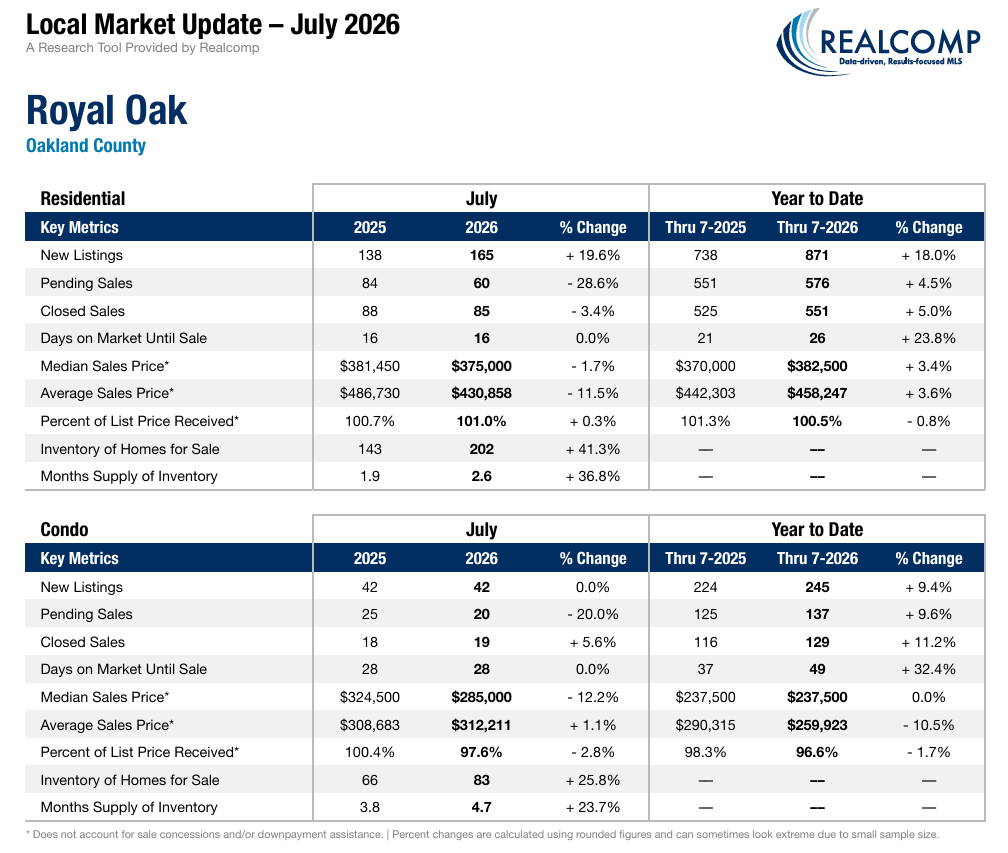
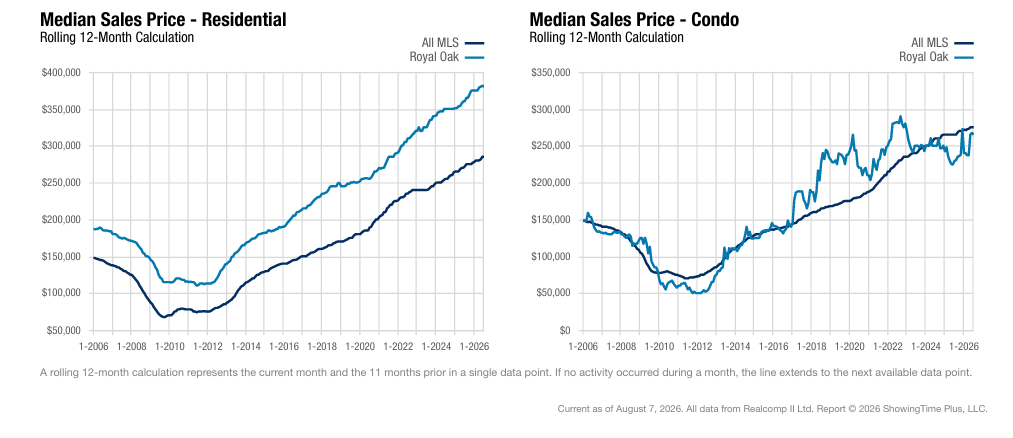
Figure 1. July 2026 Royal Oak Residential Market Snapshot — Source: Realcomp MLS
Royal Oak Residential — July 2026
Royal Oak had 202 residential homes for sale in July 2026, up 41.3% from 143 one year earlier.
Months supply increased from 1.9 to 2.6 months, while new listings increased 19.6%.
Pending sales declined 28.6% for the month.
The year-to-date numbers add important context.
Through July 2026, Royal Oak residential closed sales were up 5.0%, and the median sales price was up 3.4% to $382,500.
Buyers are still buying.
But they have more inventory to compare.
And yet Royal Oak sellers received 101.0% of list price on average in July.
That combination matters.
Competition can still happen.
But sellers cannot assume every listing will receive multiple offers—or that every offer above asking carries the same strength.
Buyer response to the individual property determines the seller's actual position.
Don't Rank the Offers. Evaluate Them.
Instead of lining up the offers:
$500,000.
$495,000.
$490,000.
And automatically choosing the first one, I want to evaluate what each buyer is actually committing to.
What is the price?
What is the financing?
What appraisal protection exists?
What are the inspection terms?
How much earnest money is being offered?
Are there seller concessions?
What contingencies remain?
What is the closing date?
What occupancy does the seller need?
Can the buyer perform?
What does the seller prioritize?
And where do we have negotiating leverage?
That is the full offer.
A seller isn't choosing a price. They're choosing a contract.
And that contract becomes the transaction we have to navigate all the way to closing.
The Signature by Lisa Offer Evaluation Strategy
When multiple offers arrive, I don't rank them by purchase price and hand the seller the highest one.
I evaluate each offer as a complete contract.
Purchase Price
What is the buyer offering?
How does that price compare with the home's market position, buyer response and competing offers?
Price matters.
But it is the starting point of the evaluation—not the end.
Financing
How is the buyer purchasing the home?
What type of financing is involved?
How much is the buyer putting down?
What documentation supports the buyer's ability to complete the purchase?
The financing tells us something about the buyer's ability to perform.
Appraisal
What happens if the home doesn't appraise at the contract price?
Does the buyer have an appraisal contingency?
Has the buyer offered appraisal-gap protection?
Does the buyer have the financial ability to cover the amount they've committed to?
This is where the strategy from What Happens If My Royal Oak Home Appraises Below the Sale Price? becomes part of evaluating the offer before we ever accept it.
Inspection
What inspection terms has the buyer proposed?
What contractual rights remain after inspection?
An inspection doesn't automatically create a problem.
But the terms determine what options may exist after the buyer completes it.
Earnest Money
How much earnest money is the buyer offering?
What does the purchase agreement provide regarding that deposit?
It is another piece of the contract—not a reason by itself to accept or reject an offer.
Seller Concessions
What is the buyer asking the seller to contribute?
A higher purchase price accompanied by significant seller concessions can produce a different financial outcome than the headline price suggests.
I want the seller comparing the actual economics of the offers, not simply the numbers written at the top.
Closing and Occupancy
When will the transaction close?
When does the buyer expect possession?
Does that timing work for the seller?
A seller who needs time to purchase another home may evaluate these terms differently from a seller whose property is already vacant.
Contingencies
What still has to happen before the buyer is required to close?
Financing.
Appraisal.
Inspection.
Sale of another property.
Or other negotiated conditions.
Each contingency can affect the path between acceptance and closing.
Buyer Ability to Perform
Finally:
Can this buyer reasonably do what they're offering to do?
A strong number means very little if the buyer doesn't have the financial ability to complete the transaction under the terms they've proposed.
That's why offer evaluation requires more than comparing prices.
The Net to the Seller Matters
Here's another reason the highest offer isn't automatically the best financial offer.
Consider:
Offer A: $510,000
Buyer requests $10,000 in seller concessions.
Offer B: $505,000
No seller concessions.
The $510,000 offer is technically higher.
But the difference in the seller's proceeds may tell a different story.
Then add financing, appraisal protection, inspection terms, occupancy and other contract terms.
Now the comparison changes again.
The headline price and the seller's actual outcome are not necessarily the same number.
This is also why Should I Leave Room to Negotiate When Pricing My Home? matters beyond the initial pricing decision.
Negotiation is not simply about moving a buyer and seller toward a number.
Price and terms work together.
What Should a Seller Counter?
Receiving multiple offers does not mean the seller has to accept one exactly as written.
There may be an opportunity to negotiate.
Maybe the strongest buyer needs to improve the price.
Maybe the highest buyer needs stronger appraisal protection.
Maybe a closing date needs to change.
Maybe the seller needs occupancy.
Maybe a concession needs to be reduced.
Maybe another term creates unnecessary risk.
The decision depends on the offers, buyer demand and the seller's priorities.
This is where representation becomes particularly important.
I want to understand:
What do we already have?
What do we want to improve?
Which buyer is most likely to agree?
What leverage has buyer demand created?
And what do we risk by countering?
A counteroffer should have a reason.
Not simply because we assume every buyer has more to give.
Multiple Offers Can Change Negotiating Leverage
This is one of the reasons creating buyer demand matters.
If one buyer is interested, the seller has one option.
If several qualified buyers are actively competing, the seller may have more.
That doesn't mean the seller can demand anything they want.
Buyers still have choices.
And as Article #92, How Do Buyers Decide What to Offer on a Home in Royal Oak?, established, buyers don't shop in a vacuum. They are evaluating the home against other properties available to them.
The seller's leverage comes from actual buyer demand, not simply from having a property for sale.
This is why preparation, presentation, pricing and marketing still matter when we're evaluating offers.
Those earlier decisions helped create the position we're negotiating from now.
Don't Create Risk Just to Chase a Higher Number
There is a point where chasing another few thousand dollars can weaken an otherwise strong contract.
Suppose a seller has an offer that already supports their goals.
Strong price.
Strong financing.
Good appraisal protection.
Acceptable inspection terms.
Closing and occupancy work.
The buyer appears capable of performing.
Could we counter for another $5,000?
Maybe.
But the question isn't only:
“Can we get more?”
It is also:
“What are we risking to get it?”
Negotiation should strengthen the seller's position when possible.
Not create unnecessary risk simply because another dollar might be available.
What Happens After We Choose the Offer?
Once the seller accepts an offer, the comparison ends.
Now we have a contract.
And everything we evaluated before acceptance begins to matter.
The financing has to move through underwriting.
The inspection period has to be completed.
The appraisal may have to support the transaction.
Title has to be addressed.
Contractual deadlines have to be met.
The buyer still has to perform.
That's exactly why What Can Cause a Home Sale to Fall Apart After Accepting an Offer in Royal Oak? follows the offer beyond acceptance.
The strength of an offer isn't fully proven when it's signed.
It's proven when it closes.
Representation Is More Than Presenting the Offers
When several offers arrive, the seller doesn't need someone simply reading the prices aloud.
The seller needs to understand what each contract means.
Where is the strength?
Where is the risk?
What does the financing tell us?
What happens if the appraisal is low?
What protections does the buyer have after inspection?
What is the seller actually netting?
Does the timing work?
Which terms should we negotiate?
Where do we have leverage?
And how does each offer support the seller's priorities?
Article #92 established this as part of the larger seller strategy: once an offer arrives, price, financing, appraisal, inspection, earnest money, closing, occupancy, contingencies, concessions and buyer ability to perform all become part of evaluating its strength.
That's representation.
Not choosing for the seller.
Giving the seller the information and strategy needed to make an informed decision.
The Signature by Lisa Perspective
Sellers work hard to get to the moment when offers arrive.
Preparation.
Presentation.
Pricing.
Marketing.
Buyer demand.
All of it helped create the opportunity.
Then the offers arrive.
Don't reduce the entire strategy to one number.
The purchase price matters.
So does financing.
Appraisal protection.
Inspection.
Earnest money.
Concessions.
Contingencies.
Closing.
Occupancy.
Buyer strength.
Seller priorities.
And negotiation.
Those terms aren't sitting behind the offer price.
They are the offer.
That's why I want sellers to remember:
A seller isn't choosing a price. They're choosing a contract.
The goal isn't automatically to accept the highest offer.
The goal is to identify and negotiate the strongest offer for the seller's priorities.
The Next Question: What Happens When You Receive Multiple Offers?
Receiving several offers creates another question:
Do you accept one?
Counter one buyer?
Counter several buyers?
Ask for highest and best?
And how do you negotiate without unnecessarily weakening the position buyer demand created?
That's our next conversation:
How Should I Handle Multiple Offers on My Royal Oak Home?
Frequently Asked Questions
Do I have to accept the highest offer on my Royal Oak home?
No. A seller can evaluate the complete terms of each offer, including price, financing, appraisal, inspection, contingencies, concessions, closing, occupancy and the buyer's ability to perform before deciding which offer best supports the seller's goals.
Is the highest offer always the best offer on a house?
No. The highest purchase price may also include terms that create additional financial or contractual risk. The complete offer should be evaluated before determining which one is strongest.
What should I look at when comparing multiple offers?
Consider purchase price, financing, appraisal protection, inspection terms, earnest money, seller concessions, contingencies, closing, occupancy and the buyer's ability to complete the transaction.
Should I accept a lower offer with better terms?
Potentially. A lower offer may provide stronger financing, better appraisal protection, fewer contingencies or terms that better support the seller's priorities. The difference in price should be evaluated alongside the differences in terms and risk.
Can I counter an offer instead of accepting the highest one?
Potentially. A seller may decide to counter an offer depending on the contract, buyer demand, seller priorities and negotiating position. Countering also carries the possibility that the buyer will not agree, so the decision should be evaluated strategically.
How do seller concessions affect which offer is highest?
Seller concessions can reduce the seller's proceeds. An offer with a higher purchase price but significant requested concessions may produce a different financial outcome than a slightly lower offer without those concessions.
Conclusion
The highest offer may be the strongest offer.
But the purchase price alone doesn't tell us that.
Price.
Financing.
Appraisal.
Inspection.
Earnest money.
Concessions.
Contingencies.
Closing.
Occupancy.
Buyer ability.
Seller priorities.
Each can affect the strength of the contract and the seller's eventual outcome.
Don't simply rank the offers.
Evaluate them.
Closing Thoughts
SELLER: “That one is the highest. Take it.”
Not so fast.
Before accepting it, understand what is attached to that number.
Because once the seller signs, that offer becomes the contract we have to navigate to closing.
A seller isn't choosing a price. They're choosing a contract.
And the strongest contract is the one that best supports the seller's goals, negotiating position and path to closing.
Find Out What Your Royal Oak Home Is Worth
Before we can evaluate the strength of an offer, we need to understand the property's probable market value, current competition and market position.
I'll evaluate the comparable sales, condition, current competition and buyer demand to help determine your home's market position and the pricing strategy that supports your selling goals.
👉 Find Out What Your Royal Oak Home Is Worth
About Lisa A. Mills
Lisa A. Mills is a REALTOR®, founder of Signature by Lisa, and is affiliated with National Realty Centers | Powered by JMG. She specializes in helping Metro Detroit homeowners confidently navigate life's transitions through strategic planning, local market expertise, and innovative digital marketing.
Known as The Calm Strategist When Life Shifts, Lisa believes selling a home begins with understanding—not assumptions. Through thoughtful preparation, strategic pricing, and a focus on buyer confidence, she helps homeowners make informed decisions that lead to stronger outcomes.