Find a few homes nearby.
Look at what they sold for.
Calculate the price per square foot.
Apply that number to your home.
There's your value.
Not so fast.
Price per square foot can be useful.
Proximity matters.
Timing matters.
Square footage matters.
Architecture matters.
Bedrooms, bathrooms, garage and basement matter.
But those criteria help me identify potential comparable sales.
They don't automatically make two homes comparable.
Because there's another question I want answered:
Would the same buyer realistically have considered both homes?
That's where comparable-sale analysis becomes much more interesting.
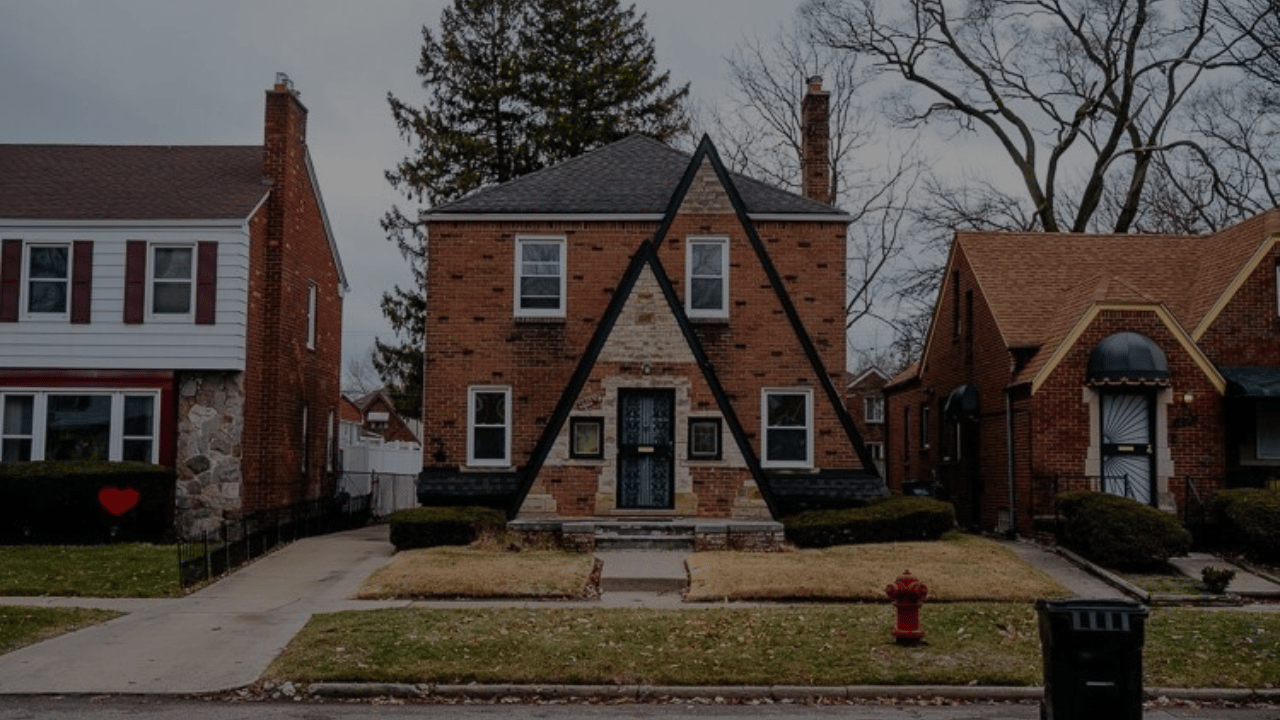
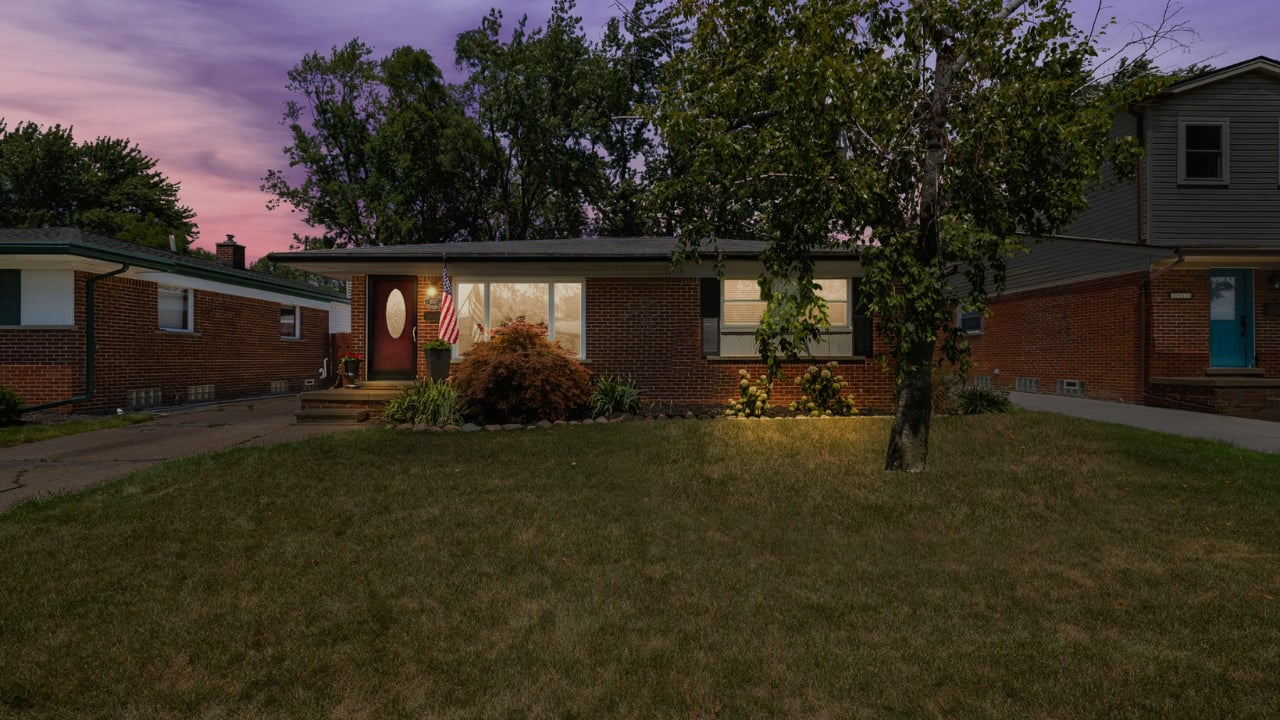
Two Royal Oak homes can sit a quarter mile apart, have nearly identical square footage and look remarkably similar on paper.
Then you walk through the front door.
One flows beautifully.
The other doesn't.
One feels bright and comfortable.
The other feels chopped up.
One has an upstairs buyers can easily imagine using.
Another technically includes the same square footage, but that space doesn't function the way buyers expected.
Same neighborhood.
Similar specifications.
Different buyer experience.
And potentially very different buyer behavior.
That's why I don't determine value by simply finding the closest homes and calculating an average price per square foot.
The numbers tell me which homes to investigate. They don't automatically tell me which homes are comparable.
Price Per Square Foot Doesn't Determine Value
Price per square foot gets a lot of attention.
Sellers use it.
Buyers use it.
Even real estate professionals use it.
And there's nothing wrong with looking at it.
The problem begins when we treat it as though it determines value by itself.
Let's say a 1,500-square-foot Royal Oak home sells for $450,000.
That's $300 per square foot.
Your home is 1,600 square feet.
It's tempting to calculate:
1,600 × $300 = $480,000.
And conclude that's what your home should be worth.
But what created that $300-per-square-foot result?
Was the kitchen completely renovated?
Did the home have two full bathrooms instead of one?
Was there a finished basement?
A two-car garage?
A more desirable lot?
Did the floor plan flow better?
Was the condition significantly different?
Did buyers walk in and immediately connect with the home?
Were multiple buyers competing for it?
Price per square foot tells me what happened mathematically. It doesn't tell me what happened inside the house.
And what happened inside the house may be exactly what caused buyers to respond differently.
That's why Should I Price My Home Based on What My Neighbor’s House Sold for in Royal Oak, Michigan? takes the comparable-sale conversation one step deeper.
Understanding how the market arrived at the sold price is the foundation for interpreting buyer behavior. The sold price is the result. Buyer behavior is what created it.
Before I use that result to establish your home's value, I first need to determine whether that home is truly comparable to yours.
What Makes a Good Comparable Sale in Royal Oak?
In Royal Oak and throughout much of the Woodward Corridor, homes are relatively close together.
That gives us an advantage when analyzing comparable sales because there may be enough sales activity to stay geographically close to the subject property.
Depending on the home and available sales, I generally begin by looking at several fundamental characteristics.
Proximity
How close is the comparable to your home?
In a dense market such as Royal Oak, we may be able to begin within approximately a quarter- to half-mile radius.
But proximity alone isn't enough.
Crossing into a different neighborhood pocket, school district, municipality or location influence can change how buyers perceive the property.
Timing
When did the home sell?
Recent sales generally give us better evidence of current buyer behavior than sales from much further back.
Appraisers may look at sales from roughly the past 90 to 120 days when appropriate, although the timeframe can expand depending on the property and availability of meaningful comparable sales.
The important point for sellers is this:
The house two doors down isn't automatically the best comparable simply because it's the closest.
If it sold much earlier under different market conditions, another more recent sale may tell us more about today's buyer.
Architecture
A ranch should ideally be compared with other ranches.
A bungalow with bungalows.
A colonial with colonials.
Architecture influences more than appearance.
It affects how buyers experience the space.
A 1,500-square-foot ranch and a 1,500-square-foot bungalow may have identical square footage on paper while living very differently in person.
Square Footage
We want reasonably similar above-grade living space.
But again, I don't stop at the number.
How that square footage functions matters.
Bedrooms and Bathrooms
The number matters, but so does functionality.
Three bedrooms aren't necessarily equal if one bedroom is unusually small or difficult to use.
The same applies to bathrooms and their location within the home.
Basement and Garage
Finished versus unfinished basement.
Full versus partial basement.
One-car versus two-car garage.
Attached versus detached.
These are features buyers evaluate when comparing their options.
Condition
This is where the spreadsheet starts becoming less useful.
Two homes can have almost identical specifications and still create very different buyer perceptions because of their actual condition.
And that's when I want to understand the home beyond the data.
What the Current Royal Oak Market Means for Sellers
Comparable sales are historical evidence.
But your home will be competing in today's market.
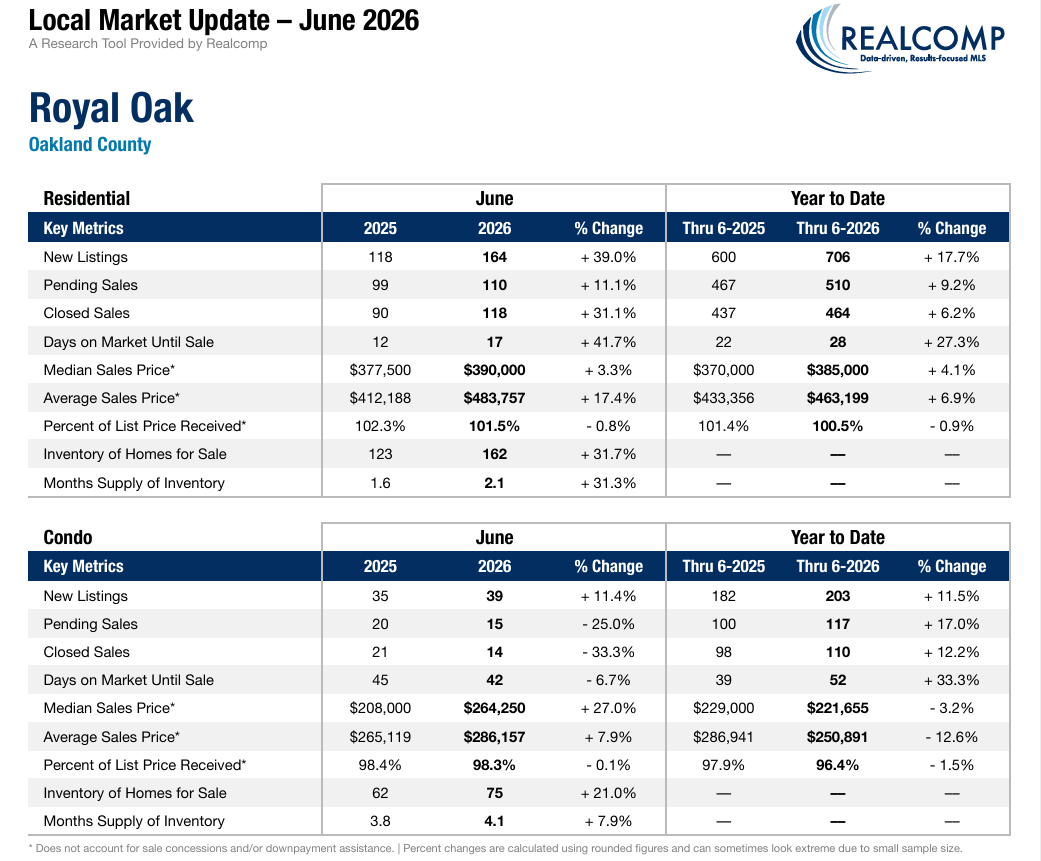
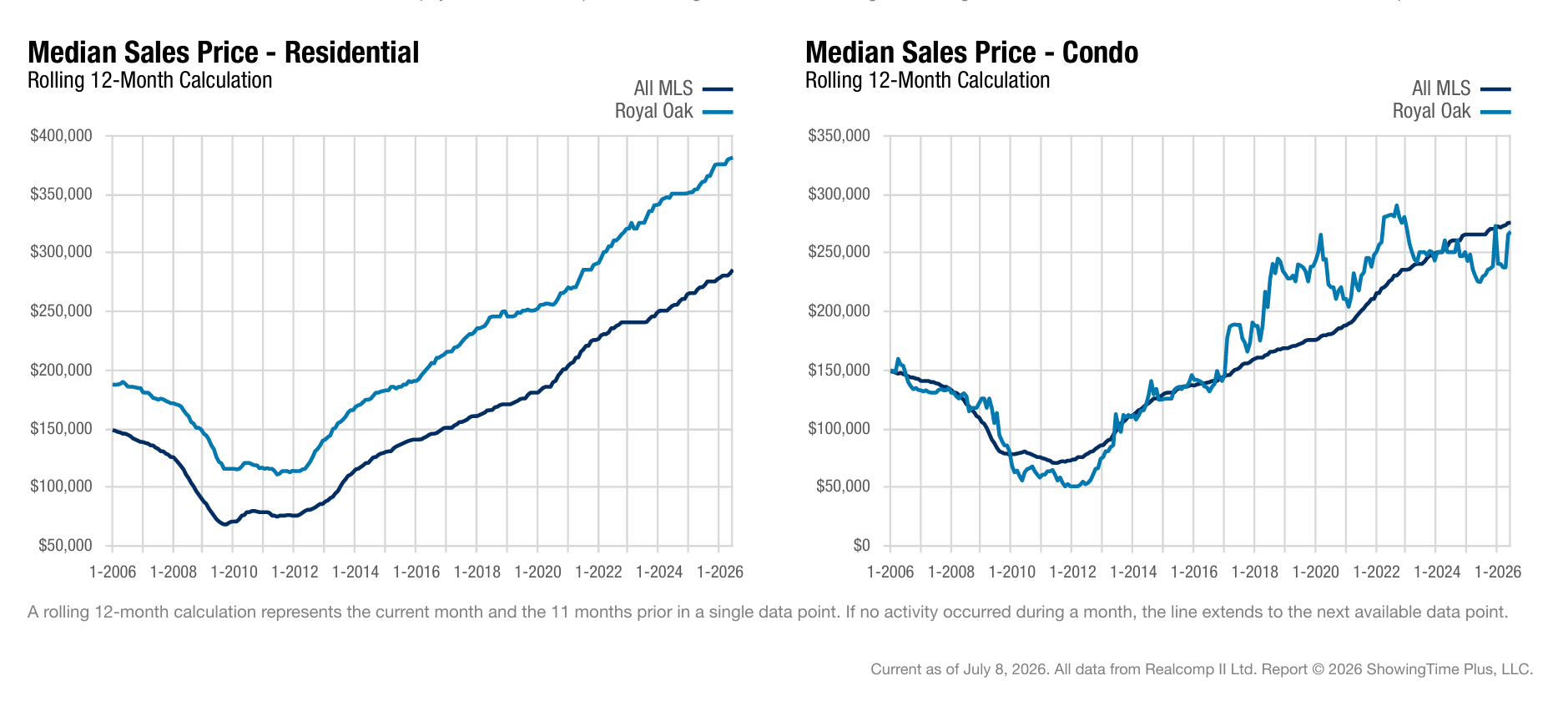
Figure 1. June 2026 Royal Oak Residential Market Snapshot (Source: Realcomp MLS)
In June 2026, Royal Oak recorded:
Those numbers provide context.
They don't determine the value of an individual Royal Oak home.
And there's one piece of the June data I think matters particularly for this conversation.
New residential listings increased 39% compared with June 2025, homes for sale increased 31.7%, and months supply increased from 1.6 months to 2.1 months.
Days on market also increased from 12 days to 17 days.
Buyers had more choices.
And that matters when interpreting comparable sales.
A home that sold during a period with fewer competing properties may have experienced a very different buying pool than a similar home entering the market when inventory has increased.
The house may be similar. The competitive environment may not be.
That's why I continually track the Royal Oak Real Estate Market Update alongside individual comparable sales.
Sold homes tell us what buyers paid.
Current market conditions help us understand the environment your home is about to enter.
The Comparable That Looked Right Until I Walked Through the Door
This is exactly why I preview properties.
Before a recent listing appointment, I went through an active home that appeared relevant enough on paper that I wanted to see it myself.
The numbers could tell me the square footage.
Bedrooms.
Bathrooms.
Location.
Price.
The listing photos could show me the finishes.
But then I walked through the house.
The flow was difficult.
And the upstairs, while technically part of the home, wasn't functionally usable in the way many buyers would expect.
That changed my interpretation of the property.
Suddenly, its lower price made more sense.
So did the lack of offers.
That's something sellers—and buyers—can easily miss when they're looking through comparable properties online.
They see:
That home is similar.
It's priced lower.
Or:
That home sold for less.
And understandably, they wonder why.
Sometimes the answer isn't obvious in the MLS data.
Sometimes you have to walk through the front door.
The buyer who experienced that property wasn't simply evaluating square footage.
They were evaluating whether the home worked for them.
That's buyer behavior.
And if my seller's home creates a fundamentally different experience, I need to account for that before treating the other property as equal evidence of value.
Condition, Flow and Vibe Aren't Fluffy Words
I know “vibe” isn't an appraisal adjustment sitting neatly inside a spreadsheet.
But buyers experience it.
I've watched it happen repeatedly during showings.
A buyer walks into one home and starts mentally arranging furniture.
They talk about where they'll put the dining table.
They picture using the backyard.
They start asking questions.
They're moving in mentally before they've written an offer.
Then we walk into another home with similar specifications.
Something doesn't connect.
Maybe the rooms feel smaller than expected.
Maybe the natural light is different.
Maybe the staircase interrupts the flow.
Maybe the kitchen feels disconnected from the living space.
Maybe an upstairs bedroom technically exists but doesn't function well for the buyer's needs.
The buyer may not say:
“I am applying a negative adjustment for functional obsolescence.”
They say:
“I don't know. I just don't like this one as much.”
That's buyer perception.
And buyer perception affects behavior.
In Should I Price My Home Below Market Value to Get Multiple Offers in Royal Oak, Michigan?, I explain why getting buyers through the door doesn't guarantee competition.
The home still has to deliver on the expectation created online.
The same principle applies to comparable sales.
If two homes created very different experiences for buyers, I need to understand that before treating their numbers as interchangeable.
The Signature by Lisa Comparable Framework
When I'm deciding whether a property deserves meaningful weight in a pricing analysis, I look at more than the sold price.
I want to understand six things:
Proximity
Is the home located where the same buyer would realistically have searched?
Timing
Did it sell recently enough to reflect relevant market conditions?
Property
Are the architecture, square footage, bedrooms, bathrooms, basement, garage and major characteristics reasonably similar?
Condition
What did the buyer actually experience when they walked through the home?
Competition
What else could that buyer purchase at the same time?
Buyer Response
Did buyers compete?
Did the home sit?
Was the price reduced?
Did it go pending quickly?
What did the market actually do?
Proximity. Timing. Property. Condition. Competition. Buyer Response.
That's how the comparable begins telling us a story.
And this is the distinction I want sellers to remember:
A comparable sale isn't just a house with similar specifications. It's a home that competed for the attention of the same buyer.
Sold, Pending and Active Homes Tell Me Different Things
When I'm developing a pricing strategy, I don't only look backward.
Sold Homes
Sold properties tell us what buyers were willing to pay and what sellers ultimately accepted.
They are evidence of completed market behavior.
Pending Homes
Pending properties tell us where buyers have recently acted.
We may not yet know the final sale price, but the fact that the home attracted an accepted offer can give us useful information about current buyer response.
Active Homes
Active listings are your competition.
They're what buyers can choose instead of your home today.
That's critical.
Because the seller isn't really competing against the home that sold three months ago.
That transaction is finished.
Today's buyer is deciding between the homes available to them now.
This is why How Do I Price My Home to Sell in Royal Oak, Michigan? focuses on positioning, not simply calculating a number from past sales.
The sold comparables help establish the evidence.
The active listings show us the competition.
The pending homes show us where buyers are acting.
And together, they help us interpret where your home belongs.
Not Every Comparable Deserves the Same Weight
This is another important distinction.
Finding six homes that meet basic comparable criteria doesn't mean I value all six equally.
One may be extremely similar in architecture, size, condition and location.
Another may be farther away but offer a more recent example of buyer behavior.
Another may be physically close but have a significantly different floor plan.
Another may have sold during a multiple-offer situation that pushed the final price higher.
And another may technically meet the criteria but have a condition issue that clearly affected buyer response.
They're all data.
But they don't necessarily tell us the same thing.
That's why comparable analysis requires judgment.
I may give one sale considerably more weight than another because I believe it better represents how the same buyer would have evaluated your home.
This is also why What Is My Home Worth in Royal Oak, Michigan? explains that market value isn't one fixed number sitting inside a database waiting to be discovered.
We're gathering evidence.
Then we're interpreting which evidence is most relevant to your home.
The goal isn't to find the comp with the number we like best.
The goal is to find the evidence that best represents how today's buyers are likely to perceive your home.
What If There Aren't Any Perfect Comparables?
Sometimes there aren't.
Even in Royal Oak, where we often have plenty of nearby housing activity, every property is different.
Maybe your home is substantially larger than surrounding properties.
Maybe it's been expanded.
Maybe it has an unusual lot.
Maybe the architecture is less common.
Maybe the condition is significantly better—or worse—than anything that recently sold nearby.
That doesn't mean we can't determine a pricing range.
It means we may need to widen the analysis carefully.
Perhaps I go slightly farther geographically.
Perhaps I look further back in time.
Perhaps one comparable helps me understand the value of the location while another gives me better evidence for size or condition.
The farther we move away from an apples-to-apples comparison, the more interpretation matters.
That's also why I don't believe in forcing a home into a formula simply because the formula feels objective.
Sometimes the best pricing analysis requires several pieces of imperfect evidence that, when interpreted together, begin telling a consistent story.
What About Price Per Square Foot?
Let's come back to this because I know how tempting the number is.
If three nearby homes sold for:
$285 per square foot.
$300 per square foot.
$315 per square foot.
It's very easy to average those numbers and multiply the result by your home's square footage.
Clean.
Simple.
And potentially misleading.
Price per square foot can help me identify patterns.
It can help me spot an outlier.
It can help me ask better questions about why one home commanded substantially more or less than another.
But I don't want the calculation replacing the analysis.
A smaller, beautifully renovated home may command a higher price per square foot than a larger home.
A home with an awkward addition may technically have more square footage without buyers valuing every additional foot equally.
A finished basement can add meaningful buyer appeal without being treated the same as above-grade living area.
A superior garage, lot, location or floor plan can influence buyer behavior without fitting neatly into a single price-per-square-foot calculation.
That's why:
Price per square foot is a data point. It is not a pricing strategy.
And if the calculation conflicts with what buyers are actually doing in the market?
I pay attention to the buyers.
Buyer Feedback Can Help Us Interpret the Comparables
Once a home reaches the market, we begin receiving another form of information.
Actual buyer response to your home.
Showings.
Second showings.
Questions.
Saved listings.
Repeat online activity.
Offers.
And sometimes silence.
That information doesn't replace the pricing analysis we completed before listing.
It helps us test it.
This is where What Happens If I Price My Home Too High in Royal Oak, Michigan? becomes important.
If comparable sales suggest one range but buyers consistently respond differently once the home is available, I don't ignore that information simply because the original CMA said something else.
I want to understand what the market is telling us.
Maybe buyers are seeing a condition issue differently than we anticipated.
Maybe new competition entered the market.
Maybe the home is receiving significant attention but something about the in-person experience is preventing offers.
Maybe buyers are responding more strongly than expected.
Comparable sales give us evidence before we launch. Buyer behavior gives us evidence after we launch.
Both matter.
A Comparable Market Analysis Isn't Just About Sold Homes
This is where the entire pricing picture comes together.
When I'm preparing a CMA, I want to understand:
What sold?
That gives us historical evidence.
What's pending?
That shows us where buyers have recently acted.
What's active?
That shows us what buyers can choose today.
What failed to sell or required a price reduction?
That can show us where buyer resistance developed.
And then:
What is happening in the broader Royal Oak market?
That's why the current Royal Oak Real Estate Market Update remains part of the pricing conversation.
A comparable sale doesn't exist in a vacuum.
Neither does your home.
And once we've determined where the home belongs, How Will My Home Be Marketed to Attract Buyers in Royal Oak, Michigan? explains the next piece: how I move beyond simply making the listing available and create repeated opportunities for buyers to discover it.
Because choosing the right comparables helps us establish the position.
Marketing gives buyers the opportunity to respond to it.
The Signature by Lisa Perspective
I can pull comparable sales from the MLS.
So can another real estate professional.
An appraiser can analyze them.
A homeowner can find sold properties online.
The difference isn't access to the numbers.
It's how those numbers are interpreted.
I want to know whether the same buyer would realistically have considered both homes.
I want to know what the buying pool looked like.
I want to know what competition existed.
I want to understand the actual condition.
The layout.
The flow.
The presentation.
The buyer experience.
And then I want to know:
How did buyers respond?
That's why previewing that active property before my recent listing appointment mattered.
I could see the price online.
I could see the square footage.
I could see the photos.
But until I walked through the home, I couldn't fully understand why buyers might react differently to it.
The spreadsheet showed me a possible comparable.
The house showed me the difference.
That's the distinction.
And it's why these two Signature by Lisa principles work together:
Understanding how the market arrived at the sold price is the foundation for interpreting buyer behavior.
And:
A comparable sale isn't just a house with similar specifications. It's a home that competed for the attention of the same buyer.
That's how I approach the evidence before recommending where your home should be positioned.
From Comparable Sales to Pricing Strategy
Once we've narrowed the comparable pool and interpreted what happened with those properties, we still aren't finished.
Now we have to make a decision.
Where should your home enter the market?
That's where How Do I Price My Home to Sell in Royal Oak, Michigan? becomes the broader strategy.
And then we need to consider the different pricing approaches we've covered throughout this Royal Oak seller series.
Should I Price My Home Below Market Value to Get Multiple Offers in Royal Oak, Michigan? looks at using price aggressively to create an opportunity for competition.
Should I Leave Room to Negotiate When Pricing My Home in Royal Oak, Michigan? explains why artificially adding money to the list price doesn't guarantee buyers will negotiate back down.
And What Happens If I Price My Home Too High in Royal Oak, Michigan? explains what buyer response can tell us when the market and asking price aren't aligned.
The comparable analysis gives us the evidence.
The pricing strategy determines what we do with it.
The Next Question: What If My Home Is Different From the Comparables?
This is the natural question after everything we've discussed.
What happens when your home has something the comparable sales don't?
A major renovation.
An addition.
An unusual floor plan.
A superior lot.
A finished basement.
An extra garage bay.
Or a condition issue that makes direct comparison difficult.
That becomes our next conversation:
(Coming Soon) How Do Updates and Condition Affect My Home's Value in Royal Oak, Michigan?
Because once we've established the best comparable properties, we need to understand how the differences between those homes and yours influence buyer perception and market position.
Frequently Asked Questions
How many comparable sales should I use to price my Royal Oak home?
There isn't one perfect number of comparable sales for every property. The goal is to identify enough relevant sales to establish a meaningful pattern. Quality matters more than quantity. A smaller group of highly comparable properties may provide better evidence than a large group of loosely related sales.
How close should comparable sales be to my Royal Oak home?
In a dense market such as Royal Oak, comparable sales may often be found within approximately a quarter- to half-mile radius, depending on the property and available sales. However, proximity alone doesn't make a home comparable. Architecture, size, condition, location and buyer appeal also matter.
How recent should comparable home sales be?
Recent sales generally provide stronger evidence of current buyer behavior. Depending on the property and available sales, looking within roughly the previous 90 to 120 days can be a useful starting point, with the timeframe expanded when necessary to find meaningful comparable properties.
Is price per square foot a good way to determine my home's value?
Price per square foot is a useful data point, but it should not determine your home's value by itself. Two homes with similar square footage can have very different condition, layouts, garages, basements, lots and buyer appeal. Those differences can significantly affect what buyers are willing to pay.
Do active and pending listings matter when pricing my home?
Yes. Sold homes provide evidence of what buyers previously paid, pending homes show where buyers have recently acted, and active listings show what buyers can choose instead of your home today. All three can provide useful information when determining market position.
Why can two similar homes sell for very different prices?
Because buyers don't experience homes as a collection of statistics. Condition, floor plan, flow, natural light, presentation, location, competition and overall buyer perception can cause two seemingly similar homes to receive very different market responses.
Conclusion
Choosing comparable sales isn't about finding the three closest homes and averaging their sold prices.
And it isn't about finding a price-per-square-foot number and multiplying.
Those calculations can give us information.
They don't give us the entire answer.
I want to know whether the same buyer would realistically have considered both properties.
I want to understand the condition.
The architecture.
The functionality.
The flow.
The competition.
The buying pool.
And ultimately:
How did buyers respond?
Because that's what turns a collection of sold properties into meaningful evidence of your home's potential market value.
Closing Thoughts
Comparable sales are incredibly important.
But choosing the right comparables requires more than matching bedrooms, bathrooms and square footage.
The numbers tell me which homes to investigate. They don't automatically tell me which homes are comparable.
Sometimes the difference becomes obvious when I study the listing history.
Sometimes it's in the market conditions.
Sometimes it's in the competition.
And sometimes I have to walk through the front door.
That's why this is the thought I want Royal Oak sellers to remember:
A comparable sale isn't just a house with similar specifications. It's a home that competed for the attention of the same buyer.
That's the buyer behavior I'm trying to understand before recommending where your home belongs in the market.
Find Out What Your Royal Oak Home Is Worth
If you're looking at nearby sales and wondering which ones actually matter for your home, start with an analysis of how your property fits into today's Royal Oak market.
I'll look beyond the sold price to evaluate the comparable properties, current competition, condition, location and buyer behavior that can influence your home's market position.
👉 Find Out What Your Royal Oak Home Is Worth
Then we can determine the pricing strategy from there.
About Lisa A. Mills
Lisa A. Mills is a REALTOR®, founder of Signature by Lisa, and is affiliated with National Realty Centers | Powered by JMG. She specializes in helping Metro Detroit homeowners confidently navigate life's transitions through strategic planning, local market expertise, and innovative digital marketing.
Known as The Calm Strategist When Life Shifts, Lisa believes selling a home begins with understanding—not assumptions. Through thoughtful preparation, strategic pricing, and a focus on buyer confidence, she helps homeowners make informed decisions that lead to stronger outcomes.