“Let's price it higher so I have room to negotiate.”
But does that actually put you in a stronger negotiating position?
You can't use a higher asking price to protect yourself from a negotiation that hasn't even happened yet.
Because we don't know yet what that negotiation will look like.
We don't know how many buyers will be interested.
We don't know how buyers will perceive the home's value.
We don't know what competing homes will be available.
We don't know whether we'll receive one offer or multiple offers.
We don't know the price and terms of that offer.
And we don't know what leverage the seller or buyer will have when the negotiation begins.
That's why I don't treat pricing and negotiation as two separate decisions.
The buyer's eventual offer and negotiating position are affected by how the home was prepared, how it was presented, where it was priced relative to the competition, what demand was created, how buyers perceived its value, the strength of the offer, and how the agents navigate the negotiation.
Those things don't happen independently.
They are the strategy.
A Higher Asking Price Doesn't Create Negotiating Leverage
The logic behind pricing high to leave room sounds straightforward.
If you want $500,000, list at $525,000.
The buyer offers less.
You negotiate.
And hopefully you end up around $500,000.
But that strategy depends on something happening first:
The buyer has to write the offer.
A buyer isn't required to negotiate from your asking price.
They can compare your home with the other properties available and decide another home offers stronger value.
They can wait.
They can move on.
Or they can decide your home isn't positioned close enough to what they believe it's worth to begin a negotiation.
That's why Should I Leave Room to Negotiate When Pricing My Home? challenges the idea that adding money to the asking price automatically protects the seller.
You can't negotiate an offer that never begins.
But there is another layer to that conversation.
Getting the offer is not the entire strategy either.
The seller's negotiating position has been developing long before that offer arrives.
Your Negotiating Position Starts Before the Home Hits the Market
Negotiation is often treated as the final step.
Prepare the house.
Take the photos.
Choose the price.
Put it on the market.
Receive an offer.
Then negotiate.
But each of those earlier decisions affects the position we have when the offer arrives.
Preparation
How the home is prepared affects what buyers experience when they walk through it.
Deferred maintenance, cleanliness, repairs and overall condition can influence buyer confidence before price is ever discussed.
That's why How to Prepare Your Royal Oak Home for Sale and What Repairs Matter Before Listing in Royal Oak? are part of the pricing strategy—not separate preparation tasks.
Presentation
Buyers usually experience the property online before they experience it in person.
Photography, video, listing presentation and the way the property is introduced establish expectations.
The in-person experience then has to support them.
Pricing
The asking price determines where the home enters the competitive market.
It affects which buyers find it, which homes they compare it against and the level of value they expect at that price.
That is the foundation of How Do I Price My Home to Sell in Royal Oak, Michigan?
Marketing
Marketing creates opportunities for buyers to discover the home.
As I explain in How Will My Home Be Marketed to Attract Buyers in Royal Oak?, putting a property in the MLS makes it available.
Strategic marketing is about creating broader and repeated opportunities for the right buyers to see it.
Buyer Demand
Exposure alone isn't leverage.
Buyer response matters.
If several buyers believe the home offers value and want to pursue it, the seller may enter negotiations from a different position than if one buyer is interested.
Representation
Then the offer arrives.
Now the strength of the offer, the seller's priorities, the buyer's position, competing interest and the way the agents navigate the negotiation all matter.
These aren't separate events.
Each one affects what comes next.
Buyers Don't Shop in a Vacuum
The seller knows what they paid for the home.
What they invested in it.
What they want to receive.
The buyer approaches the property differently.
They're looking at their choices.
What else can I buy for this amount of money?
They may have already toured several homes.
They may have saved competing properties online.
They may know another listing is coming soon.
They may have watched a home they liked sell before they were ready to act.
They are constantly building a frame of reference for value.
That is why Which Comparable Sales Should I Use to Determine My Royal Oak Home's Value? asks whether the same buyer would realistically have considered both properties.
Comparable sales aren't just numbers for a CMA.
They represent previous buyer decisions.
Current listings represent the decisions buyers can make today.
Buyers don't shop in a vacuum.
Your home is being evaluated against those alternatives.
Price Creates an Expectation
The asking price does more than communicate what the seller wants.
It creates an expectation of what the buyer should receive for that amount of money.
At one price, an older kitchen may make sense.
At another, buyers may expect it to be updated.
At one price, a one-car garage may be competitive.
At another, buyers may have several two-car garage alternatives.
At one price, buyers may accept certain condition issues.
At another, those same issues may become objections.
This is why How Do Updates and Condition Affect My Home's Value in Royal Oak, Michigan? separates the cost of improvements from the value buyers place on them.
The buyer isn't adding up what the seller spent.
They're deciding how the entire property compares with what else their money can buy.
What the July 2026 Royal Oak Market Tells Us About Buyer Choice
That comparison becomes more important when buyers have more inventory available.
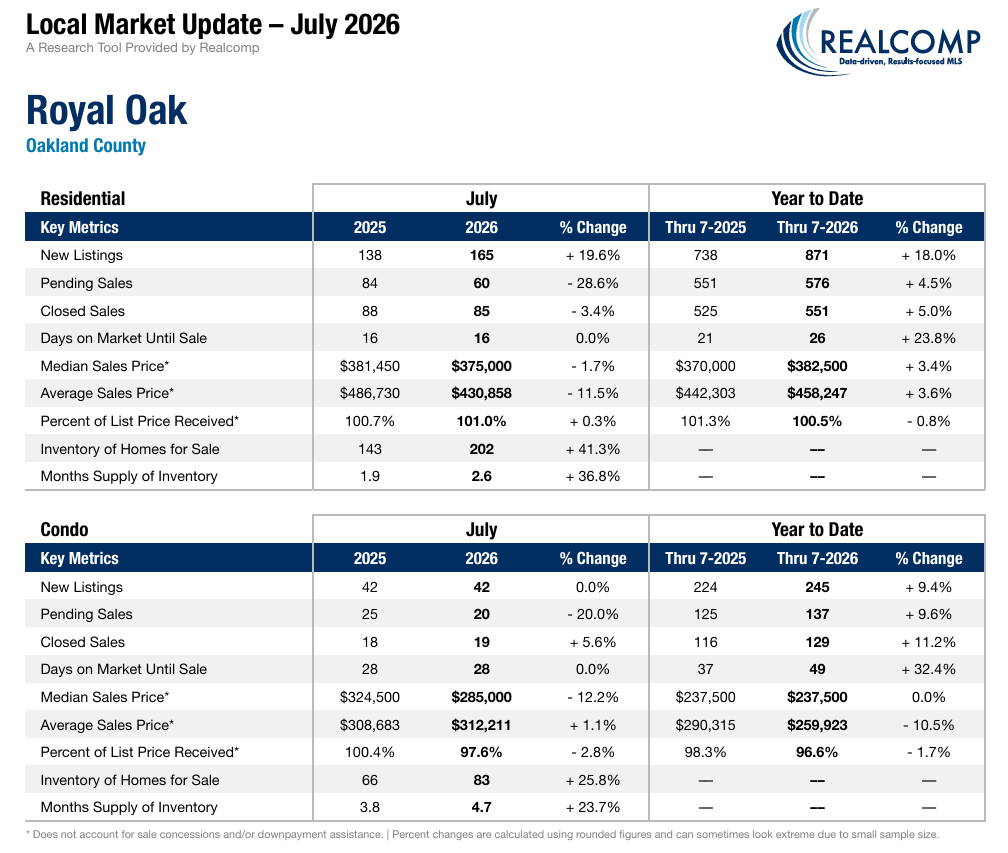
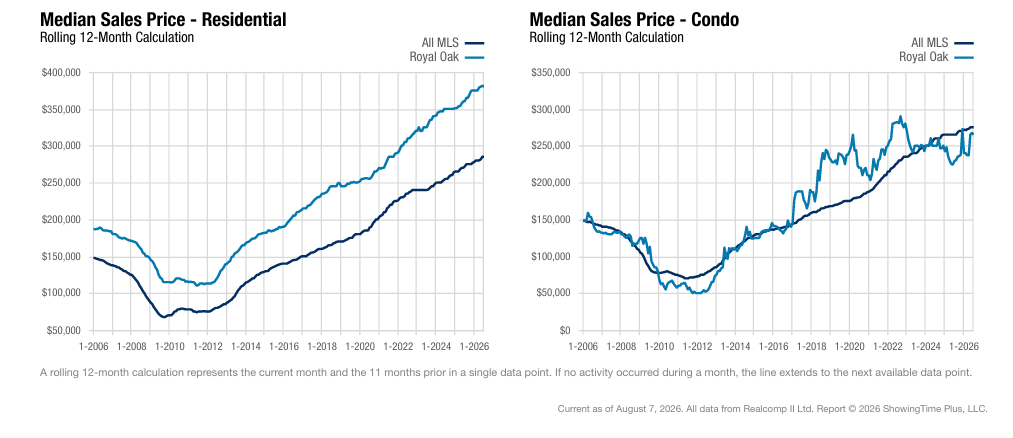
Figure 1. July 2026 Royal Oak Residential Market Snapshot — Source: Realcomp MLS
Royal Oak Residential — July 2026
Royal Oak had 202 residential homes for sale in July 2026, up 41.3% from 143 one year earlier.
Months supply increased from 1.9 to 2.6 months, while new listings increased 19.6%.
Pending sales declined 28.6% for the month.
The year-to-date numbers add important context.
Through July 2026, Royal Oak residential closed sales were up 5.0%, and the median sales price was up 3.4% to $382,500.
Buyers are still buying.
But they have more inventory to compare.
That matters when determining how a home should be positioned.
A higher asking price doesn't remove those alternatives.
It changes which alternatives buyers use to evaluate your home.
The Strategy Is Bigger Than the Asking Price
Instead of asking:
“How high can we price the home so we have room to negotiate?”
I want to answer a different question:
“How do we build the strongest possible position for the seller?”
That starts before the price is selected.
How should the home be prepared?
How should it be presented?
Where should it be positioned relative to the competition?
How will buyers discover it?
What buyer demand can we create?
How are buyers responding?
What does the eventual offer actually contain?
What leverage do we have?
And how should that offer be negotiated?
That is the full strategy.
Preparation + Presentation + Pricing + Marketing + Buyer Demand + Representation + Negotiation
They work together.
And they all affect the outcome.
The Signature by Lisa Seller Strategy
When I represent a seller, I don't look at the transaction as a series of unrelated services.
The strategy builds in layers.
Prepare the Home
Preparation establishes the product we're bringing to market.
The goal isn't to make every home perfect or completely renovated.
It's to identify what needs attention before buyers begin evaluating it.
Present the Home
Presentation establishes the buyer's first impression and expectations.
Photography, video, property details and the in-person experience need to work together.
Position the Home
Market valuation tells us what the evidence supports.
Pricing strategy determines how we enter the market.
That distinction is why What Is My Royal Oak Home Worth? and the pricing strategy are connected but not identical questions.
Market the Home
Marketing creates exposure.
The goal is to put the property in front of the buyers most likely to respond to it and create repeated opportunities for discovery.
Create Buyer Demand
Demand isn't guaranteed by a list price or marketing campaign.
Buyers still decide whether the property represents value.
But when preparation, presentation, positioning and exposure work together, we create the opportunity for buyer interest to become competition.
That's the distinction behind Should I Price My Home Below Market Value to Get Multiple Offers?
The price alone doesn't create multiple offers.
Buyer demand does.
Evaluate the Offer
Once an offer arrives, I look beyond the headline price.
Price matters.
So do the terms.
Financing.
Appraisal.
Inspection.
Earnest money.
Closing.
Occupancy.
Contingencies.
Seller concessions.
And the buyer's ability to perform.
The strongest offer is not automatically the offer with the highest number.
Navigate the Negotiation
Then we negotiate from the position we've built.
One interested buyer creates one negotiating environment.
Several interested buyers can create another.
A strong offer with clean terms creates a different decision than a higher offer carrying greater risk.
The seller's priorities matter.
The buyer's position matters.
The market matters.
And representation matters.
The negotiation is not isolated from everything that came before it.
Representation Is Part of the Strategy
This is the piece that can get lost when sellers think only about asking price and offer price.
The agents matter.
Once an offer is received, someone has to interpret it.
What is strong?
What creates risk?
Where do we have leverage?
Where might the buyer have leverage?
What terms matter to the seller?
What should we counter?
What shouldn't we counter?
What information should be communicated to the other side?
How should the negotiation be handled without unnecessarily weakening the seller's position?
The buyer's eventual offer and negotiating position are affected by how the home was prepared, how it was presented, where it was priced relative to the competition, what demand was created, how buyers perceived its value, the strength of the offer, and how the agents navigate the negotiation.
That is why representation belongs inside the strategy.
Not after it.
The Highest Offer Is Not Automatically the Strongest Offer
Consider two offers.
One has the highest purchase price but includes financing risk, an appraisal contingency, inspection protections and terms that don't align with the seller's timing.
Another is slightly lower but provides stronger financing, cleaner terms and a closing structure that better matches the seller's priorities.
Which is better?
There isn't enough information in the purchase price alone to answer that.
The seller needs to understand the complete offer.
This is where representation moves from presenting an offer to interpreting it.
Price matters.
So does the probability of reaching closing on the terms the seller is willing to accept.
Demand Changes the Negotiation
Buyer demand can change leverage.
If one buyer is interested, we negotiate with one buyer.
If several qualified buyers are actively pursuing the property, the seller may have more options.
That is one reason Should I Price My Royal Oak Home Above Market Value? can't be answered by simply saying a higher asking price gives the seller more negotiating room.
A higher asking price that reduces buyer response may create less leverage.
A well-positioned home that generates stronger buyer demand may create more.
That's why I focus on the market response rather than the asking price alone.
Pricing Is One Layer, Not the Entire Strategy
Pricing matters.
A lot.
But pricing cannot compensate for every other part of the listing.
A strong price with poor presentation can affect buyer response.
Strong marketing with weak positioning can create exposure without offers.
Beautiful presentation without enough exposure can limit the buyer pool.
An excellent offer can still be mishandled during negotiation.
Each layer has a job.
And each layer affects the others.
That is why the Signature by Lisa strategy is not:
Pick the highest asking price and negotiate later.
It is:
Prepare. Present. Position. Market. Create demand. Evaluate. Negotiate.
One strategy.
What If the Buyer Makes a Low Offer?
A low offer is information.
It is not automatically an insult.
And it doesn't automatically mean the seller should accept it, reject it or split the difference.
I want to understand the context.
How long has the property been available?
What activity have we had?
Are other buyers interested?
How does the offer compare with the market evidence?
What terms are included?
What does the buyer's agent communicate?
What are the seller's priorities?
What leverage exists?
Then we determine the response.
This is another reason I don't want to artificially create “negotiating room” before we know what we're negotiating.
The strategy should respond to the actual offer and the actual market—not an imagined negotiation before the home is listed.
The Signature by Lisa Perspective
Sellers deserve more than a list price.
They deserve a strategy for how that price fits into the complete sale.
The asking price doesn't protect the seller by itself.
Neither does marketing.
Neither does preparation.
Neither does negotiation.
The strength comes from how those pieces work together.
That's why this is the statement I want sellers to remember:
The buyer's eventual offer and negotiating position are affected by how the home was prepared, how it was presented, where it was priced relative to the competition, what demand was created, how buyers perceived its value, the strength of the offer, and how the agents navigate the negotiation.
Those aren't separate events.
They are the strategy.
The Next Question: What Happens After We Accept the Offer?
An accepted offer isn't the finish line.
Inspection.
Appraisal.
Financing.
Title.
Closing.
The seller's strategy continues through each stage.
That's our next conversation:
(Coming Soon) What Can Cause a Home Sale to Fall Apart After Accepting an Offer in Royal Oak?
Frequently Asked Questions
Should I price my Royal Oak home higher so I have room to negotiate?
Not automatically. A higher asking price can change how buyers compare your home with competing properties. If buyers don't perceive enough value to write an offer, there is no negotiation to begin.
How do buyers decide what to offer on a home?
Buyers consider comparable sales, current competition, condition, price, market demand and their perception of the home's value. The presence of competing buyers and the terms they need can also affect the offer they write.
Does the asking price determine what buyers will offer?
No. The asking price establishes the home's market position, but buyers determine their offers based on the property, comparable evidence, available alternatives, demand and their own negotiating position.
Does having multiple offers give a seller more negotiating leverage?
It can. Multiple interested buyers may give a seller more options on price and terms. The strength of each offer still needs to be evaluated individually.
Is the highest offer always the best offer?
No. Purchase price is one part of an offer. Financing, appraisal, inspection, contingencies, earnest money, closing, occupancy and other terms can affect the strength and risk of the offer.
Why does the seller's agent matter during negotiation?
The seller's agent evaluates the offer, identifies strengths and risks, considers market response and competing interest, communicates with the buyer's agent and helps the seller determine how to respond based on the seller's goals and negotiating position.
Conclusion
A higher asking price does not create negotiating leverage by itself.
The seller's position is built through the entire listing strategy.
Preparation.
Presentation.
Pricing.
Marketing.
Buyer demand.
Buyer perception.
Offer strength.
Representation.
Negotiation.
Each affects the next.
Closing Thoughts
“Let's price it higher so I have room to negotiate.”
Before making that decision, look at the entire strategy.
The goal isn't to protect yourself from a negotiation that hasn't happened.
The goal is to build the strongest possible position before the negotiation begins—and then know how to navigate it when it does.
Preparation, pricing, buyer demand, representation and negotiation all work together.
That's the strategy.
Find Out What Your Royal Oak Home Is Worth
Before determining where to price your Royal Oak home, start by understanding its probable market value and how it will compete with the homes buyers can choose today.
I'll evaluate the comparable sales, condition, current competition and buyer demand to help determine your home's market position and the pricing strategy that supports your selling goals.
👉 Find Out What Your Royal Oak Home Is Worth
About Lisa A. Mills
Lisa A. Mills is a REALTOR®, founder of Signature by Lisa, and is affiliated with National Realty Centers | Powered by JMG. She specializes in helping Metro Detroit homeowners confidently navigate life's transitions through strategic planning, local market expertise, and innovative digital marketing.
Known as The Calm Strategist When Life Shifts, Lisa believes selling a home begins with understanding—not assumptions. Through thoughtful preparation, strategic pricing, and a focus on buyer confidence, she helps homeowners make informed decisions that lead to stronger outcomes.