“My neighbor's house sold for $500,000, and my house is nicer.”
I hear the logic.
And your neighbor's sale absolutely matters.
But it doesn't automatically establish what your home is worth.
Your neighbor's sale is evidence.
It isn't your price.
Because the sold price is only the final number.
What I want to understand is:
How did the market arrive at that sold price?
Was the home priced at $500,000 and one buyer offered full price?
Was it listed at $475,000 and multiple buyers competed until the price reached $500,000?
Did it originally list at $525,000, sit on the market, reduce its price and eventually negotiate to $500,000?
Were there seller concessions?
What other homes were buyers choosing from at the time?
How quickly did buyers respond?
And what did that home offer that buyers valued enough to pay $500,000?
Those details change how I interpret the sale.
Understanding how the market arrived at the sold price is the foundation for interpreting buyer behavior.
The sold price is the result. Buyer behavior is what created it.
And if we're going to use your neighbor's sale to help position your home, I want to understand both.
The assumption sounds reasonable.
Your neighbor has a three-bedroom Royal Oak home.
You have a three-bedroom Royal Oak home.
Their home sold for $500,000.
Your kitchen is newer.
Your basement is finished.
Your yard is bigger.
So your home should be worth at least $500,000—maybe more.
Maybe.
But that's not enough information for me to make that conclusion.
Because buyers don't determine value by standing in your kitchen and asking:
“Is this house nicer than the one that sold down the street six months ago?”
They're looking at what they can purchase now.
That's the distinction.
Sellers naturally compare houses.
Buyers compare choices.
Your neighbor's home may be one of the comparable sales I use to understand your home's potential value.
But today's buyer is also comparing your home against the homes currently available to them.
And those choices may be completely different from the choices buyers had when your neighbor sold.
That's why a comparable sale has to be interpreted, not simply copied.
In What Is My Home Worth in Royal Oak, Michigan?, I explain why market value is different from a Zestimate, assessed value or appraisal. A neighboring sale is another important piece of evidence—but no single number tells the entire story.
A Sold Price Is the End of the Story
This is where I believe sellers can learn much more from comparable sales.
When you look at a sold listing online, you see the ending.
Sold: $500,000.
I want to rewind the story.
What was the original list price?
Were there price reductions?
How many days was it on the market?
Did it go pending immediately?
Did it return to the market?
Was there strong competition?
Did the seller offer concessions?
How did the home compare with other properties available at the same time?
What did the photography and presentation communicate?
What was happening with inventory?
And ultimately:
What did buyers do?
Because consider these three homes:
Home A
Listed at $475,000.
Multiple buyers competed.
Sold for $500,000.
Home B
Listed at $525,000.
Sat on the market.
Reduced to $510,000.
Negotiated to $500,000.
Home C
Listed at $500,000.
Received one strong offer.
Sold for $500,000.
All three homes have the same sold price.
But the market told us three completely different stories.
Home A may tell us buyers perceived enough value to compete beyond the asking price.
Home B may tell us the original pricing wasn't supported and the market eventually pulled the seller back toward $500,000.
Home C may tell us the seller and one qualified buyer found agreement around the original asking price.
Same result.
Different buyer behavior.
That's why I don't stop at the sold column.
What the Current Royal Oak Market Means for Sellers
Comparable sales also need to be interpreted within the market you're entering today.
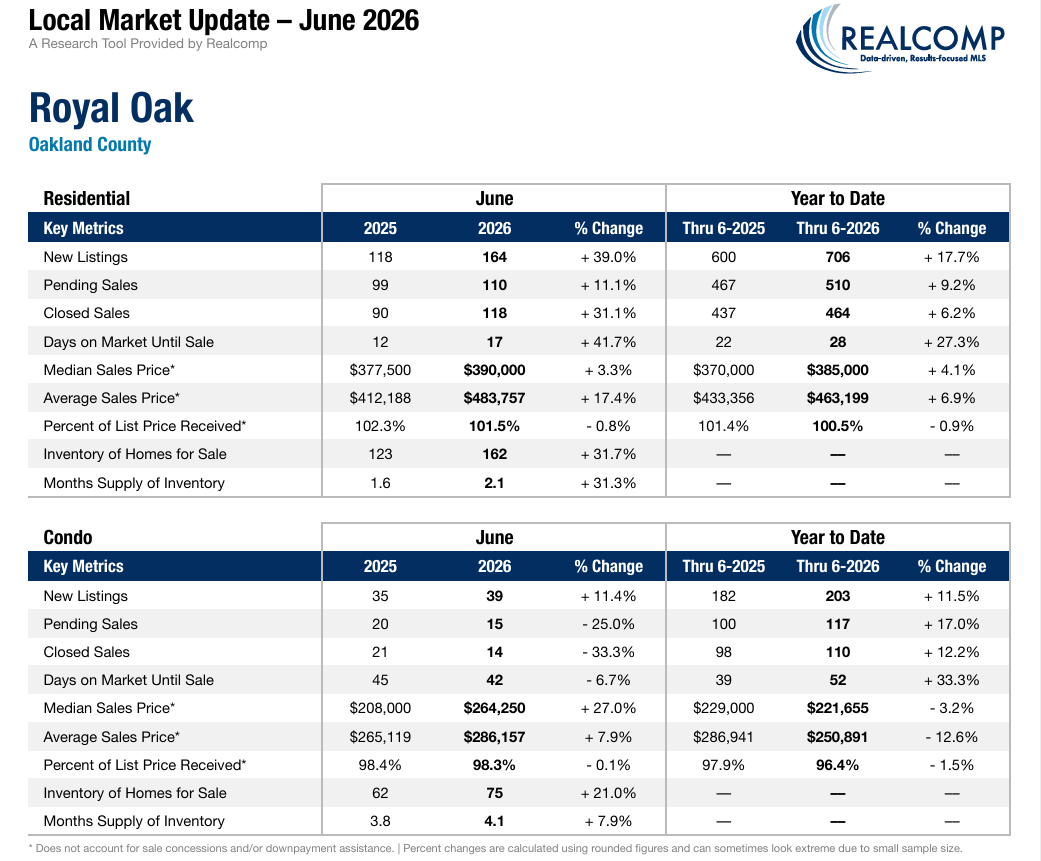
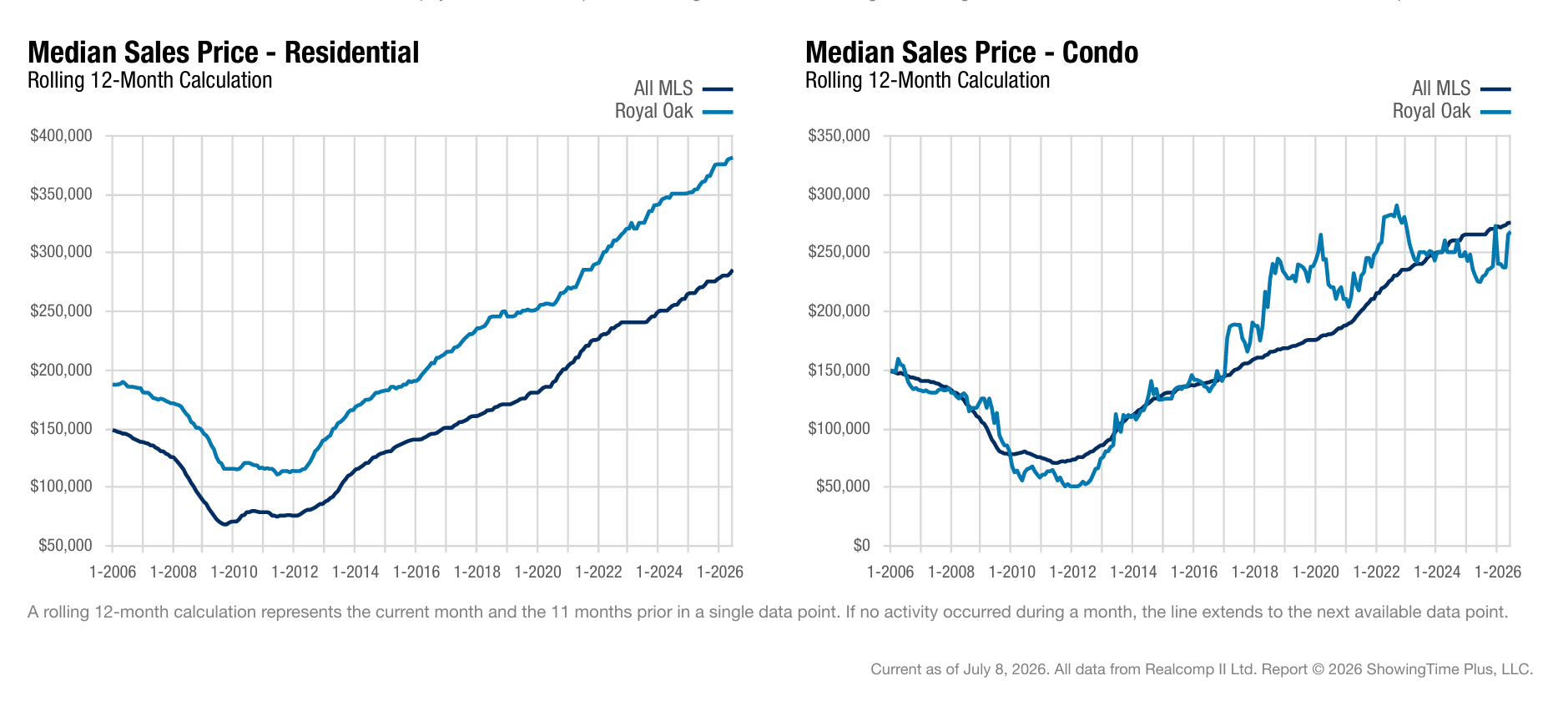
Figure 1. June 2026 Royal Oak Residential Market Snapshot (Source: Realcomp MLS)
In June 2026, Royal Oak recorded:
The numbers give us important context.
But just like your neighbor's sold price, they need interpretation.
An average sale price of $483,757 doesn't mean your Royal Oak home is worth $483,757.
And 101.5% of list price received doesn't mean every seller should expect to sell above asking.
At the same time, Royal Oak had 39% more new residential listings than June 2025, while the number of homes for sale increased 31.7% and months supply increased from 1.6 to 2.1 months.
Days on market also increased from 12 to 17 days.
That tells me buyers had more choices than they did one year earlier.
And when buyers have more choices, the competitive environment surrounding an individual home matters even more.
That's why a neighbor's sale from several months ago cannot simply be transferred onto your home without considering what has changed around it.
You can follow those changes through my Royal Oak Real Estate Market Update, where I break down the local numbers and, more importantly, what they mean for homeowners.
The Comparable Isn't Just the House
This is where I want to take the comparable-sales conversation one step further.
Of course I compare the physical property.
Square footage.
Bedrooms.
Bathrooms.
Garage.
Basement.
Lot.
Updates.
Condition.
Location.
Style.
Those things matter.
But I also want to compare the market circumstances surrounding the sale.
Because a comparable isn't simply:
House versus house.
It's also:
Market moment versus market moment.
Suppose your neighbor's home sold during a week when very few comparable Royal Oak homes were available.
Several buyers may have been competing for limited inventory.
Now suppose your home comes to market when three similar properties have just listed within the same price range.
Your house didn't suddenly become less attractive.
The buyer's choices changed.
And buyer choices influence buyer behavior.
This is why How Do I Price My Home to Sell in Royal Oak, Michigan? goes beyond simply pulling recent comparable sales. Pricing requires us to understand the competition your home will face when it actually enters the market.
The comp helps establish evidence.
Current competition helps determine position.
The Signature by Lisa Sold-Price Framework
When I'm studying a comparable sale, I want to understand five things:
Position
Where did the home begin?
What was the original list price, and how was it positioned against the competition?
Response
How did buyers react?
Did showings and offers develop quickly, or did the property struggle to gain traction?
Competition
What else could buyers purchase at that moment?
Was inventory limited, or did buyers have several comparable choices?
Perception
What did buyers appear to value—or reject—about the property?
Condition, updates, layout, location and presentation all influence perception.
Result
Where did the market ultimately land?
What was the final sold price, and were there other terms or concessions that help explain the outcome?
Position. Response. Competition. Perception. Result.
The result is important.
But it's the last step.
If we only look at the sold price, we're starting at the end of the story.
A Royal Oak Sale Can Tell Us More Than “What It's Worth”
This is where my experience working with buyers becomes just as important as my experience representing sellers.
I've walked through enough homes with buyers to know they don't evaluate properties on a spreadsheet.
They react.
They compare.
They notice the things sellers sometimes overlook.
A home may have a beautifully renovated kitchen but a floor plan buyers struggle with.
Another may be less updated but have a layout buyers immediately understand.
One may have stronger curb appeal.
Another may have the garage, primary bedroom size or finished basement that buyers in that price range are prioritizing.
That's why two homes that look very similar on paper can produce very different buyer reactions.
We saw that exact principle in Should I Price My Home Below Market Value to Get Multiple Offers in Royal Oak, Michigan?
Price can create the opportunity for competition.
Buyer perception determines whether that competition actually develops.
The same principle applies when analyzing your neighbor's sale.
I don't simply want to know that buyers paid $500,000.
I want to understand:
What made them willing to pay it?
That's the information we can actually use.
Your Neighbor's Sale Is Evidence. It Isn't Your Strategy.
Your neighbor's sale may be an excellent comparable.
It may help establish the range.
It may reveal what buyers recently paid for similar square footage, condition, location and features.
It may even become one of the strongest pieces of evidence supporting your home's value.
But then we still have another decision to make:
How should your home be positioned today?
That's strategy.
And as we discussed in Should I Leave Room to Negotiate When Pricing My Home in Royal Oak, Michigan?, list price affects more than the eventual negotiation.
It influences which buyers may see the home and what competing properties they're going to compare it against.
So I don't want to take your neighbor's sold price, add $25,000 because your kitchen is nicer and call that the pricing strategy.
I want to understand what happened.
Why buyers responded.
What has changed since then.
What buyers can purchase now.
And where your home fits within those choices.
Your neighbor's sale gives us evidence from the past.
Our job is to use that evidence to make a decision about the market in front of us.
What Buyers Paid Matters. Why They Paid It Matters More.
This is where comparable sales become useful beyond simply establishing a price range.
Let's say we're looking at three recent Royal Oak sales.
On paper, all three look reasonably comparable to your home.
Similar square footage.
Similar bedrooms and bathrooms.
Similar neighborhood.
Similar age.
But then I start digging deeper.
One home received multiple offers during its first weekend.
Another sat for three weeks before negotiating an offer.
Another sold quickly, but the seller contributed toward the buyer's closing costs.
Now I have more information.
The sold prices still matter.
But I'm beginning to understand the buyer behavior behind those prices.
This is exactly why I don't want sellers looking at one neighborhood sale and assuming:
“That's what buyers will pay for mine.”
The better question is:
“What caused buyers to respond to that home the way they did?”
Maybe it was price.
Maybe condition.
Maybe presentation.
Maybe there was very little competing inventory.
Maybe the floor plan solved something buyers weren't finding elsewhere.
Maybe several of those factors worked together.
That's the information we can use when determining how your home should enter the market.
Because a comparable sale should do more than give us a number.
It should teach us something.
Multiple Offers Can Change How We Interpret a Comparable Sale
This is especially important when a neighboring home sold significantly above its original asking price.
A seller may see:
Listed: $475,000
Sold: $500,000
And conclude:
“The house was worth $500,000.”
Possibly.
But I want to know what happened between those two numbers.
Were there two offers?
Five?
Ten?
Did one buyer dramatically outperform the others?
Was there an escalation clause?
Were buyers waiving or modifying contingencies?
Did the buyer offer appraisal-gap protection?
Was the home intentionally positioned below its anticipated market value to create competition?
Those details matter because competition can influence the final sale price.
That's exactly what I explored in Should I Price My Home Below Market Value to Get Multiple Offers in Royal Oak, Michigan?
A strategically aggressive list price can create the opportunity for competition.
But buyer perception determines whether that competition actually develops.
So when I'm using a multiple-offer sale as a comparable, I don't automatically assume another home will reproduce the same outcome.
I want to understand what created it.
The sale gives us evidence of what happened.
It doesn't guarantee it will happen again.
A Price Reduction Tells Us Something Too
Now flip the example.
Your neighbor originally listed at $525,000.
The home sat.
The price was reduced.
Eventually it sold for $500,000.
The seller sees:
Sold: $500,000.
I see more.
I see that buyers were initially presented with one price and didn't respond strongly enough to create a sale.
Then something changed.
The price.
Perhaps the competition.
Perhaps market conditions.
Eventually a buyer and seller found agreement at $500,000.
That's valuable information.
In What Happens If I Price My Home Too High in Royal Oak, Michigan?, I explain why market response has to be interpreted rather than viewed simply as success or failure.
A price reduction isn't automatically proof that the original strategy was terrible.
But it is information.
The market responded differently at one price than it did at another.
That behavior becomes part of the comparable.
And if we're considering that sale when positioning your home, I want to understand it.
Seller Concessions Can Change the Story Behind the Sold Price
There's another detail homeowners may not see when they look at a neighboring sale online.
The terms of the transaction.
Suppose a home sold for $500,000.
Did the seller contribute $10,000 toward the buyer's closing costs?
Did the seller agree to repairs?
Was there another negotiated concession?
Those terms don't erase the $500,000 sale price.
But they provide additional context around how the transaction came together.
That's why I don't believe sellers should evaluate comparable properties using the sold-price column alone.
The same principle applies when we're evaluating your potential proceeds.
The number a home sells for and the amount a seller ultimately walks away with are different conversations. How Much Does It Cost to Sell a Home in Royal Oak, Michigan? explains the expenses and negotiated items that can influence a seller's final net proceeds.
Price matters.
Terms matter.
Context matters.
The deeper we understand the transaction, the more useful that comparable becomes.
The Signature by Lisa Perspective
This is where my philosophy around comparable sales is different.
I don't believe my job is simply to pull three sold homes, average the prices and hand a seller a number.
That's data.
Strategy requires interpretation.
I want to know:
Where did the home start?
How did buyers respond?
What competition existed?
What did buyers appear to value?
What changed during the listing?
And where did the market ultimately land?
Because:
Understanding how the market arrived at the sold price is the foundation for interpreting buyer behavior.
The sold price is the result. Buyer behavior is what created it.
That's the information I want when I'm sitting across the table from a seller deciding how to position their home.
Your neighbor's $500,000 sale matters.
But I want to know why it became a $500,000 sale.
That distinction matters because we're not trying to recreate someone else's transaction.
We're trying to understand what their transaction can teach us about yours.
And that's ultimately what I mean when I say:
The market is always telling us something.
My job is to interpret what it's saying.
Your Home Still Has to Compete in Today's Market
Once we've analyzed the historical sales, we turn forward.
Because buyers aren't shopping through last month's sold listings.
They're shopping through today's available homes.
That's why I don't want to finish a pricing analysis with:
“These three houses sold around $500,000, so let's list at $500,000.”
I want to know:
What will be active when we launch?
What homes are pending?
Which properties just reduced their prices?
What new competition is coming onto the market?
What does $500,000 buy a Royal Oak buyer today?
And where does your home fit within those choices?
That's also why I track the current Royal Oak Real Estate Market Update rather than relying exclusively on historical comparable sales.
Sold homes tell us what buyers did.
Active competition helps us understand what buyers can do next.
We need both.
And this is where How Will My Home Be Marketed to Attract Buyers in Royal Oak, Michigan? becomes part of the conversation too.
Once we've established the position, buyers still need to discover the home, understand the value and experience it in a way that supports the strategy.
Comparable sales help us understand the market.
Positioning determines how we enter it.
The Next Question: Which Comparable Sales Actually Matter?
Once sellers understand that one neighboring sale doesn't determine their home's value, the next question naturally becomes:
Which sales should we actually use?
Because not every home that sold nearby is a meaningful comparable.
Distance matters.
Timing matters.
Square footage matters.
Style matters.
Condition matters.
Location within Royal Oak matters.
But as we've established throughout this article, buyer behavior matters too.
That is the next layer of the pricing conversation:
Which Comparable Sales Should I Use to Determine My Royal Oak Home's Value?
Because choosing the right comparables is just as important as interpreting them correctly.
Frequently Asked Questions
Should I price my home based on what my neighbor's house sold for?
Your neighbor's sale can be an important comparable, but it should not determine your price by itself. Your home's condition, size, layout, location, current competition and today's buyer demand also influence market value. The circumstances behind your neighbor's sale should be interpreted before using it to position your home.
Why can two similar homes in Royal Oak sell for different prices?
Two similar homes can experience different buyer demand because of condition, updates, layout, location, presentation, competition and market timing. One property may also receive multiple offers while another negotiates with a single buyer. Similar homes do not always create identical buyer behavior.
Does a home that sold over asking mean it was underpriced?
Not necessarily. Selling above asking can result from strong buyer demand, multiple offers, strategic positioning or a combination of factors. The original list price and final sold price should be evaluated alongside the number of buyers competing and the terms of the transaction.
Should seller concessions be considered when looking at comparable sales?
Yes. Seller concessions and other negotiated terms can provide useful context around a sale. The recorded sold price remains important, but understanding the terms can help explain how the buyer and seller ultimately reached agreement.
How recent should comparable sales be when pricing my Royal Oak home?
Recent sales are generally more useful because they reflect more current buyer behavior and market conditions. However, the strongest comparable is not always simply the newest sale. Similarity in location, size, condition, style and buyer appeal should also be considered.
How do I know which neighboring homes are actually comparable to mine?
A useful comparable should share meaningful characteristics with your home, including location, property type, size, condition and features. The sale should also be interpreted within the market conditions and competition that existed when it sold rather than selected solely because it is nearby.
Conclusion
Your neighbor's sale matters.
It may become one of the strongest comparable sales we use.
But the sold price is only where the story ended.
To understand what that sale tells us about your home, we need to know how it got there.
What was the position?
How did buyers respond?
What competition existed?
What did buyers perceive?
And what ultimately created the result?
That's how a comparable becomes more than a number.
It becomes information we can use.
Closing Thoughts
A sold sign tells you what happened.
It doesn't tell you why.
And when I'm determining how to position your Royal Oak home, the why matters.
Because we're not trying to copy your neighbor's result.
We're trying to understand it.
Understanding how the market arrived at the sold price is the foundation for interpreting buyer behavior.
The sold price is the result.
Buyer behavior is what created it.
And buyer behavior is what we need to understand before asking today's buyer to choose your home.
Find Out What Your Royal Oak Home Is Worth
If you're looking at your neighbor's sale and wondering what it means for your home, start by understanding how your property fits within today's Royal Oak market.
I'll look at the comparable sales, current competition, condition, location and buyer behavior surrounding those sales to help establish your home's potential market position.
👉 Find Out What Your Royal Oak Home Is Worth
One clear starting point.
Then we build the strategy from there.
About Lisa A. Mills
Lisa A. Mills is a REALTOR®, founder of Signature by Lisa, and is affiliated with National Realty Centers | Powered by JMG. She specializes in helping Metro Detroit homeowners confidently navigate life's transitions through strategic planning, local market expertise, and innovative digital marketing.
Known as The Calm Strategist When Life Shifts, Lisa believes selling a home begins with understanding—not assumptions. Through thoughtful preparation, strategic pricing, and a focus on buyer confidence, she helps homeowners make informed decisions that lead to stronger outcomes.