“We can always start high and reduce the price later.”
You can.
But here's what I want sellers to understand before making that decision.
Buyers don't experience your price reduction the same way they experienced your home when it first came on the market.
Your home is no longer new.
They've already seen it.
They've already compared it to other homes.
And in many cases, they've already decided what they believe it's worth.
You can reduce the price later. What you can't recreate is your home's first introduction to the market.
That doesn't mean every home needs to be priced low.
It doesn't mean a price reduction automatically means something went wrong.
And it certainly doesn't mean there's one perfect number that guarantees a sale.
Pricing your home is a science.
The goal is to understand the market, your home's value, the competition and buyer expectations—and then marry those factors together to position your home to create strong buyer demand.
That's the difference between simply choosing a list price and developing a pricing strategy.
What Actually Happens When a Home Is Priced Too High?
The first thing I want sellers to understand is that buyers are paying attention.
They know what else is available.
They've probably looked at the homes you're competing against.
They've seen recent price reductions.
They've saved properties.
They've toured others.
And by the time your home enters their search, they're already developing a sense of value.
When your price and their perception of value don't align, they don't necessarily make a lower offer.
Sometimes they don't make an offer at all.
They may not even schedule the showing.
That's an important distinction.
Sellers sometimes assume an interested buyer will simply come through the home and negotiate.
But first, the buyer has to believe the home is worth seeing.
Your price helps them make that decision.
That's why pricing isn't simply about what you want to receive for your home.
Pricing is part of your positioning.
Royal Oak Market Snapshot
Before deciding whether a home is priced too high, we need to understand the market it's competing in.
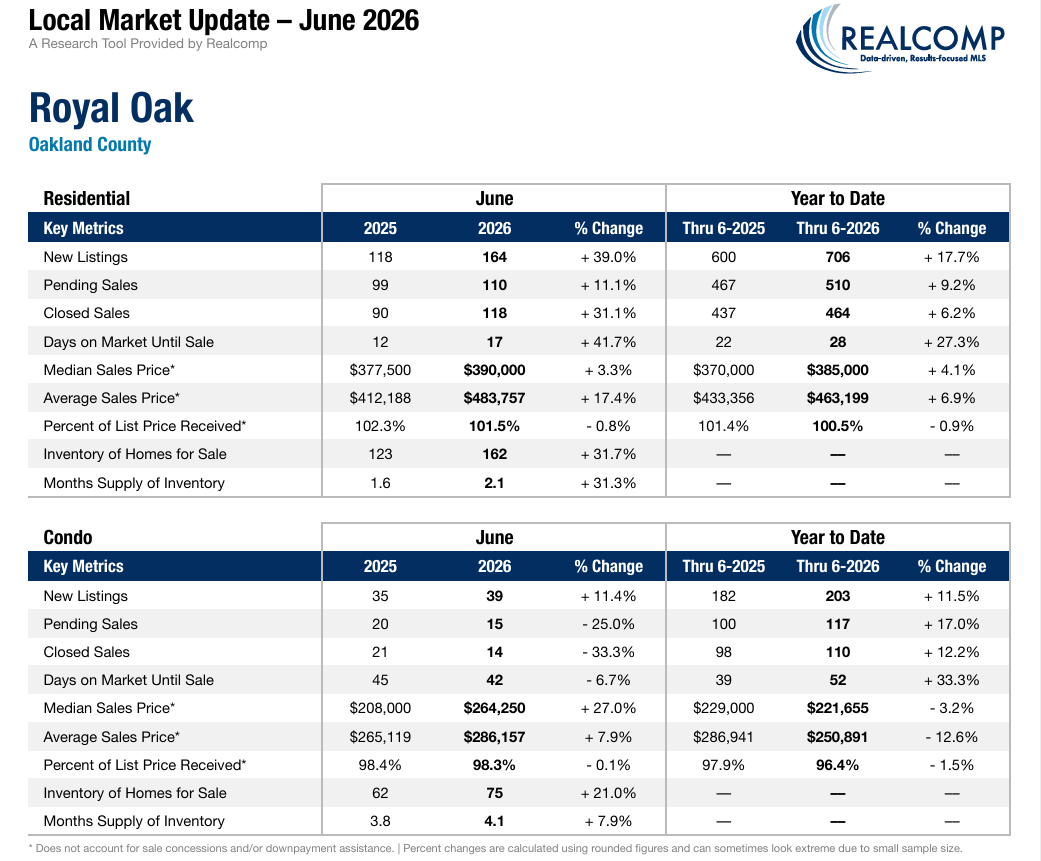
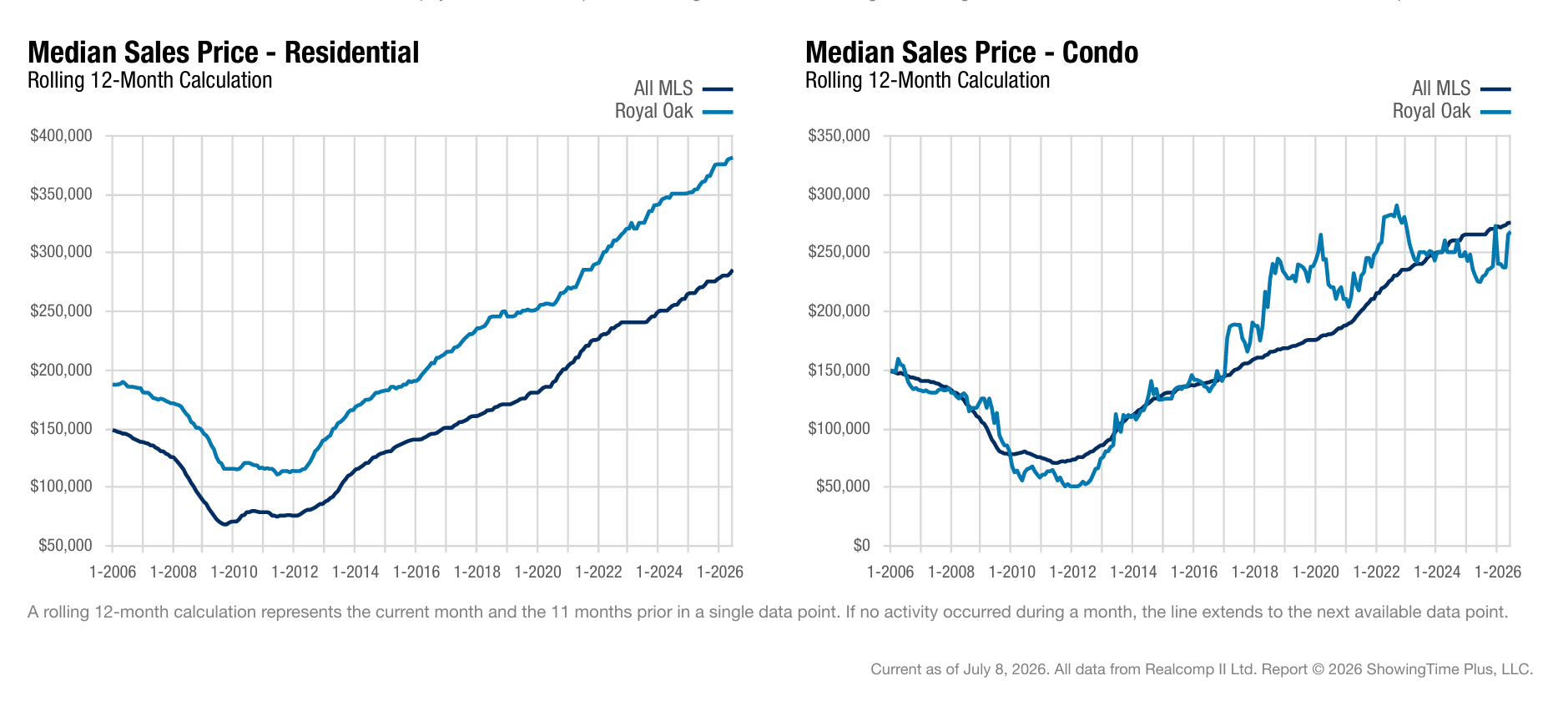
Figure 1. June 2026 Royal Oak Residential Market Snapshot (Source: Realcomp MLS)
In June 2026, the average Royal Oak residential sale price was $483,757.
But that number does not mean your Royal Oak home is worth $483,757.
It's market context.
Royal Oak contains different neighborhoods, architectural styles, home sizes, lot sizes, levels of renovation and price points. Two homes located only blocks apart can compete very differently once buyers begin comparing them.
That's why I don't price a home from one statistic.
And I don't price it from a Zestimate.
I look at what has sold, what is currently competing for the same buyer, the condition and presentation of the property, current buyer demand and how the home fits within that market.
That's the work behind the number.
If you want a deeper explanation of how I establish market positioning, read How Do I Price My Home to Sell in Royal Oak, Michigan?
And if you're still trying to determine what your property itself may be worth, What Is My Home Worth in Royal Oak, Michigan? explains why assessed value, appraised value, online estimates and actual market value can tell very different stories.
The Market Doesn't Know What You Need From the Sale
This is one of the harder pricing conversations.
You may have a number you need.
Maybe it's based on what you paid for the home.
What you've invested in renovations.
The amount you need for your next purchase.
What your neighbor sold for.
Or the amount you want to walk away with after your costs of selling your Royal Oak home are paid.
Those numbers matter to you.
But they don't determine market value.
Buyers don't know what you need from the sale.
They're evaluating your home against their other choices.
That doesn't mean we ignore your financial goals.
Quite the opposite.
I want to understand those goals before we ever discuss a listing price.
But then we have to compare your goal with what the market is telling us.
Sometimes those numbers align beautifully.
Sometimes they don't.
Knowing that before you list gives you choices. Discovering it after the market responds gives you fewer.
Visibility and Buyer Response Are Not the Same Thing
This is where pricing and marketing can easily get confused.
A home can receive significant online exposure and still not generate the response a seller expected.
Thousands of views don't automatically mean thousands of interested buyers.
Hundreds of saves don't guarantee an offer.
And more advertising cannot force buyers to accept a price they don't believe the market supports.
That's why I separate two questions:
Are buyers seeing the home?
and
How are buyers responding after they see it?
Those are completely different questions.
In How Will My Home Be Marketed to Attract Buyers in Royal Oak, Michigan?, I explain how I use the MLS, digital advertising, video, search and repeated exposure to increase the opportunities buyers have to discover a listing.
But marketing has another benefit.
It gives us information.
When we know buyers are seeing the property but the showing activity or offers don't follow, we have to pay attention.
Sometimes presentation is the issue.
Sometimes condition is creating hesitation.
Sometimes another property entered the market and changed the competition.
And sometimes—
the market is responding to the price.
A Real Royal Oak Pricing Example
I experienced this with one of my own Royal Oak listings.
We originally listed the home at $515,000.
That number was at the very top of the pricing range I had established for the property, and I told the sellers before we listed that I believed it was a stretch.
They wanted to try it.
I understood why.
Like many sellers, they wanted to make sure they weren't leaving money on the table.
But once the home reached the market, we began getting information back.
We had buyer exposure.
We had showings.
And after seven days, the sellers listened to my recommendation and we repositioned the home at $499,000—where I believed we should have started.
But something important happened next.
The price wasn't the only thing buyers were responding to.
We continued to have showings, but buyer feedback began revealing another challenge we hadn't fully anticipated before going to market:
the flow of the home.
That's an important distinction.
When a home isn't receiving offers, it's easy to immediately assume the answer is another price reduction.
Sometimes it is.
Sometimes it isn't.
The market was showing us that buyers were finding the property, touring it and considering it—but something about the home itself was creating hesitation.
Eventually, we received an offer at $475,000.
We countered at $495,000 and ultimately negotiated a sale price of $490,000.
The lesson from this listing isn't that we should have simply kept reducing the price until someone bought it.
It's that market response has to be interpreted.
Pricing was one part of the conversation.
Buyer exposure was another.
The home's layout and flow became another.
And negotiation ultimately determined where the buyer and seller were willing to meet.
That's why pricing a home isn't about choosing a number and defending it.
It's about knowing where you started, watching how buyers respond, understanding why they're responding that way, and making the right strategic decision from there.
The Signature by Lisa Pricing Framework
When I'm evaluating price, I'm looking at more than comparable sales.
I look at five things together:
Market
What are buyers doing in the current Royal Oak market?
Competition
What other homes can this buyer purchase right now?
Condition
How does your home compare when buyers see it online and in person?
Buyer Expectation
What does a buyer expect to receive at this price point?
Response
Once the home is exposed to the market, what are buyers actually doing?
Market. Competition. Condition. Expectation. Response.
The list price gets the attention.
The response gives us information.
That's why I believe pricing should remain a conversation throughout the listing—not a number we choose once and then defend regardless of what the market tells us.
And that conversation starts before your home ever reaches the MLS.
The condition of your home can influence how buyers perceive value, which is why What Repairs Should You Make Before Selling Your Home in Royal Oak? is an important part of the pricing conversation.
The same is true of preparation. How to Prepare Your Home for Sale in Royal Oak, Michigan explains how presentation can influence the confidence buyers feel when they first experience your home.
Price doesn't operate independently of those things.
Buyers experience the entire home—and then decide what they believe it's worth.
A Price Reduction Isn't Automatically a Failure
This is important because I don't believe sellers should fear a price reduction.
Markets move.
New competition appears.
Buyer demand changes.
And sometimes the market simply gives us information we couldn't completely know before launching.
The mistake isn't necessarily making a price adjustment.
The mistake is refusing to listen when the market is clearly responding.
There is a significant difference between strategically repositioning a property based on new information and repeatedly chasing the market downward because we started from a number buyers never supported.
That's also why I don't automatically subscribe to the idea that a home that doesn't sell immediately is somehow a failed listing.
In How Quickly Will My Home Sell in Royal Oak & Birmingham, Michigan?, I explain why days on market need context.
The question isn't simply:
How many days has the home been listed?
The better question is:
What has the market been telling us during those days?
That distinction matters.
A home with strong showing activity but repeated buyer hesitation is telling us something different than a home buyers aren't seeing at all.
A home receiving showings but no offers may require us to examine price, condition, presentation or buyer feedback.
A home receiving very little exposure may require an entirely different conversation about marketing.
That's why How Will My Home Be Marketed to Attract Buyers in Royal Oak, Michigan? is the natural companion to this pricing conversation.
Price influences buyer response. Marketing helps us see that response.
Neither should be evaluated in isolation.
Starting High Can Change Who Sees Your Home
There's another consequence of pricing high that sellers don't always consider.
Price determines which buyers find your home in the first place.
Buyers often search within specific price ranges.
A buyer whose maximum search is $500,000 may never see a home listed at $515,000.
That means starting above an important search threshold doesn't simply ask buyers to pay more.
It can change the buyer pool you're initially exposing the home to.
Then, when the price is later reduced, your home may appear in front of a new group of buyers—but those buyers are now seeing a listing that has already been on the market.
That doesn't mean the opportunity is lost.
It means the strategy has changed.
This is one reason I want the pricing conversation to happen alongside the home-value conversation before we launch. What Is My Home Worth in Royal Oak, Michigan? explains why market value isn't determined by one Zestimate, appraisal, tax value or seller expectation.
We have to understand where the market sees the home before deciding where to position it.
Your Net Proceeds and Your Market Value Are Two Different Conversations
Sellers aren't wrong for caring about what they walk away with.
You should.
Your mortgage payoff, transfer taxes, title costs, negotiated concessions, moving expenses and other selling costs all affect your final proceeds.
That's why understanding the costs of selling a home in Royal Oak before listing is important.
But there's a distinction I want sellers to understand:
Your net proceeds help determine whether selling makes financial sense for you.
They do not determine what a buyer believes the home is worth.
Those two conversations eventually have to meet.
This is where planning before listing becomes so valuable.
Once we understand a realistic market range and estimate the expenses associated with the sale, you can evaluate your potential proceeds before deciding whether the timing and strategy work for you.
That creates clarity before emotion enters the negotiation.
The Signature by Lisa Perspective
I don't believe the goal of pricing is to prove how much your home is worth.
The goal is to discover where your home and the market meet.
That requires data.
But it also requires interpretation.
I want to know how buyers are behaving.
What they're choosing instead.
What they're willing to tour.
What they're saving.
Where we're seeing hesitation.
And whether the market response matches the strategy we created before launch.
That's why I challenge the idea that you should simply “start high and see what happens.”
You absolutely can.
But understand what you're testing.
You're not testing the price.
You're testing buyer willingness to respond to the price.
And the market will answer.
That's also why I don't view pricing as a one-time conversation at the listing appointment.
We establish the strategy.
We launch.
We watch.
We interpret.
And when the market gives us meaningful information, we decide what—if anything—needs to change.
That's pricing strategy.
Frequently Asked Questions
What happens if you price a house too high?
Pricing a home above what buyers believe the market supports can reduce showing activity and buyer interest. Some buyers may wait for a price reduction, while others may choose competing homes instead. The important thing is to evaluate both exposure and buyer response before determining whether price is the issue.
Can I start high and lower my price later?
Yes. A seller can adjust the asking price after listing. However, buyers experience a price-reduced listing differently than a brand-new listing. They may have already seen and compared the property, which is why the original pricing strategy deserves careful consideration.
Does a price reduction make buyers think something is wrong with the house?
Not necessarily. Buyers understand that prices change. A thoughtful price adjustment can reposition a property within the market and introduce it to buyers searching within a different price range. The reason for the adjustment and the home's overall market response matter.
Will buyers just make an offer if they think my home is overpriced?
Some will, but others won't. Buyers may skip a property entirely if they believe the asking price is significantly above its value, especially when other homes offer stronger perceived value.
How do I know if price is the reason my home isn't selling?
Start by separating exposure from response. If buyers aren't seeing the home, marketing may be part of the problem. If buyers are seeing it but aren't scheduling showings or making offers, price, condition, presentation or competition should be evaluated.
How do I determine the right price for my Royal Oak home?
Pricing should consider recent comparable sales, current competition, your home's condition and location, buyer expectations and current market demand. A local market analysis provides more useful context than relying on one automated online estimate.
Closing Thoughts
You can always change a price.
You can't relaunch the same home as brand new to the same buyers.
That's why I want sellers to understand the strategy before we choose the number.
Price your home based on the market in front of you.
Watch what buyers do.
And when the market gives you information—
listen to it.
Find Out What Your Royal Oak Home Is Worth
Before deciding where to price your home, start by understanding how it fits into today's Royal Oak market.
Comparable sales are part of that analysis.
So are current competition, condition, location and buyer expectations.
👉 Find Out What Your Royal Oak Home Is Worth
One clear starting point.
Then we build the strategy from there.
About Lisa A. Mills
Lisa A. Mills is a REALTOR®, founder of Signature by Lisa, and is affiliated with National Realty Centers | Powered by JMG. She specializes in helping Metro Detroit homeowners confidently navigate life's transitions through strategic planning, local market expertise, and innovative digital marketing.
Known as The Calm Strategist When Life Shifts, Lisa believes selling a home begins with understanding—not assumptions. Through thoughtful preparation, strategic pricing, and a focus on buyer confidence, she helps homeowners make informed decisions that lead to stronger outcomes.