Yes. The housing market is slowing down.
I'm not going to tell you it isn't.
I can see it in the numbers.
And I'm seeing it in the field.
Buyers have more choices. Inventory is higher. Some homes are taking longer to sell. Buyers have more room to think, compare and negotiate.
But slower doesn't mean collapsing.
And it doesn't mean homeowners suddenly lost the equity they've spent years building through real estate.
Here's where I think the conversation gets confused:
We're confusing market velocity with market value.
How quickly homes are selling and what homeowners have built in equity are two very different conversations.
The headlines tend to focus on what's happening right now.
More inventory.
Fewer sales.
Price reductions.
Higher mortgage rates.
Buyers gaining leverage.
And those things matter.
But your home isn't only a transaction happening in October 2026.
It's also an asset.
And for homeowners who have owned their properties for years, that asset may represent a significant amount of accumulated equity.
The September 2026 numbers give us an excellent example of how both stories can be happening at exactly the same time:
The market can slow down while property values continue to grow.
The Market Is Slowing. The Numbers Say So.
What's Happening in Oakland County?
Let's start with Oakland County.
According to Realcomp's September 2026 residential data, inventory increased from 2,511 homes in September 2025 to 3,024 homes in September 2026.
That's a 20.4% increase in inventory.
Months supply increased from 2.4 months to 2.9 months, up 20.8%.
Pending sales declined 7.3% year over year.
Closed sales declined 4.8%.
Days on market increased slightly, from 24 days to 25 days. Oakland County Sept 2026
Those numbers matter.
Buyers have more choices.
When buyers have more choices, they don't necessarily have to rush into the first acceptable house they see.
They can compare.
They can wait.
They can negotiate.
They can decide that a property's condition doesn't justify its price.
They can decide that another home is simply a better value.
So yes:
The market is slowing.
But now let's look at what didn't happen.
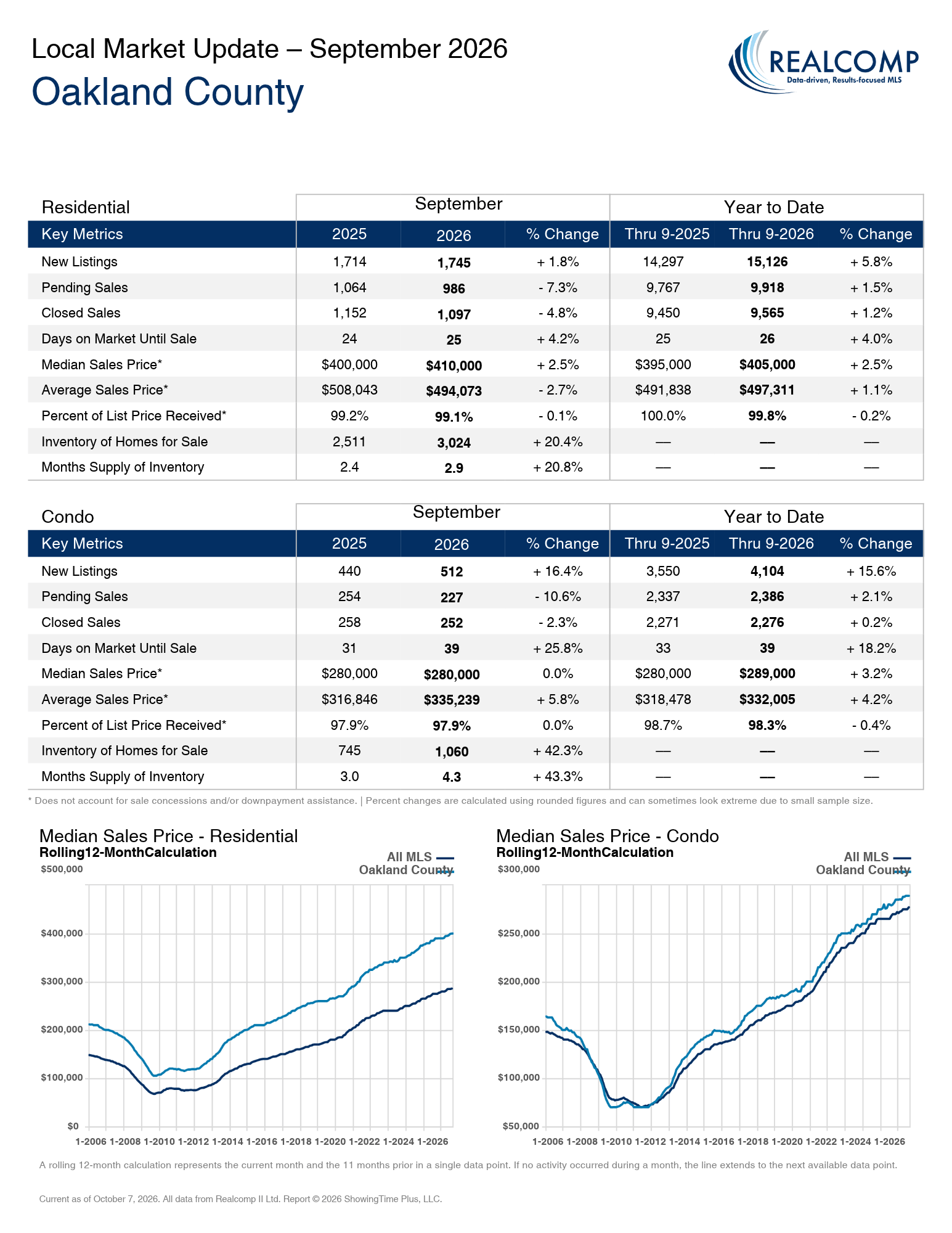
September 2026 Oakland County housing market statistics showing residential inventory, home prices, sales activity and months supply.
SOURCE: Realcomp II Ltd. — September 2026 Local Market Update, current as of October 7, 2026.
Stop Confusing Velocity With Value
While Oakland County inventory increased more than 20% and both pending and closed sales declined, the median residential sales price did not decline.
It increased.
The Oakland County median residential sales price rose from $400,000 in September 2025 to $410,000 in September 2026.
That's a 2.5% year-over-year increase.
And this isn't simply one month creating an unusual comparison.
Year to date through September, the Oakland County median residential sales price increased from $395,000 in 2025 to $405,000 in 2026, also up 2.5%.
The year-to-date average residential sales price increased as well, from $491,838 to $497,311. Oakland County Sept 2026
Read those two stories together:
Inventory is up.
Buyer choice is up.
Sales activity has softened.
And median residential values are still higher than they were one year ago.
That's why I don't think sellers should confuse speed with value.
A home taking longer to sell does not automatically mean housing values are collapsing.
If you're wondering whether the slowdown is affecting local prices, here's a closer look Are Home Prices Dropping in Royal Oak Michigan?
More listings entering the market doesn't automatically erase homeowner equity.
And a buyer having more negotiating power doesn't suddenly undo years of appreciation.
Market velocity and market value are not the same thing.
That builds directly on what I discussed in Is the Metro Detroit Housing Market Depressed? What Sellers Need to Understand
The answer wasn't to deny that the market was changing.
It was to ask:
Which market?
Because there are markets within markets—and September's numbers make that distinction even clearer.
Royal Oak Tells an Even More Interesting Story
Now let's narrow the market.
September 2026 Royal Oak residential inventory increased from 163 homes to 217 homes year over year.
That's a 33.1% increase.
Months supply increased from 2.2 to 2.8 months, up 27.3%.
Again:
More inventory. More buyer choice.
But look at everything else.
Pending residential sales increased 18.0%.
Closed residential sales increased 14.1%.
Days on market actually decreased from 19 days to 17 days.
The median sales price increased from $365,563 to $384,000, up 5.0%.
The average sales price increased from $399,250 to $431,065, up 8.0%.
And Royal Oak residential sellers received an average of 99.7% of list price during September. Royal Oak Sept 2026
Year to date, Royal Oak's residential median price increased from $370,000 to $383,050, while the average sales price increased from $436,620 to $449,467. Royal Oak Sept 2026
So what exactly is “the market”?
Because if we only looked at rising inventory, we could tell one story.
If we only looked at prices, we could tell another.
If we only looked at sales activity, we'd have another.
Good market analysis requires looking at all of it.
I've talked about this changing buyer environment before in Royal Oak Housing Market August 2026: What Sellers Need to Know.
More buyer choice doesn't mean the market stopped working.
It means sellers have to understand the market they're entering—and compete intentionally inside it.
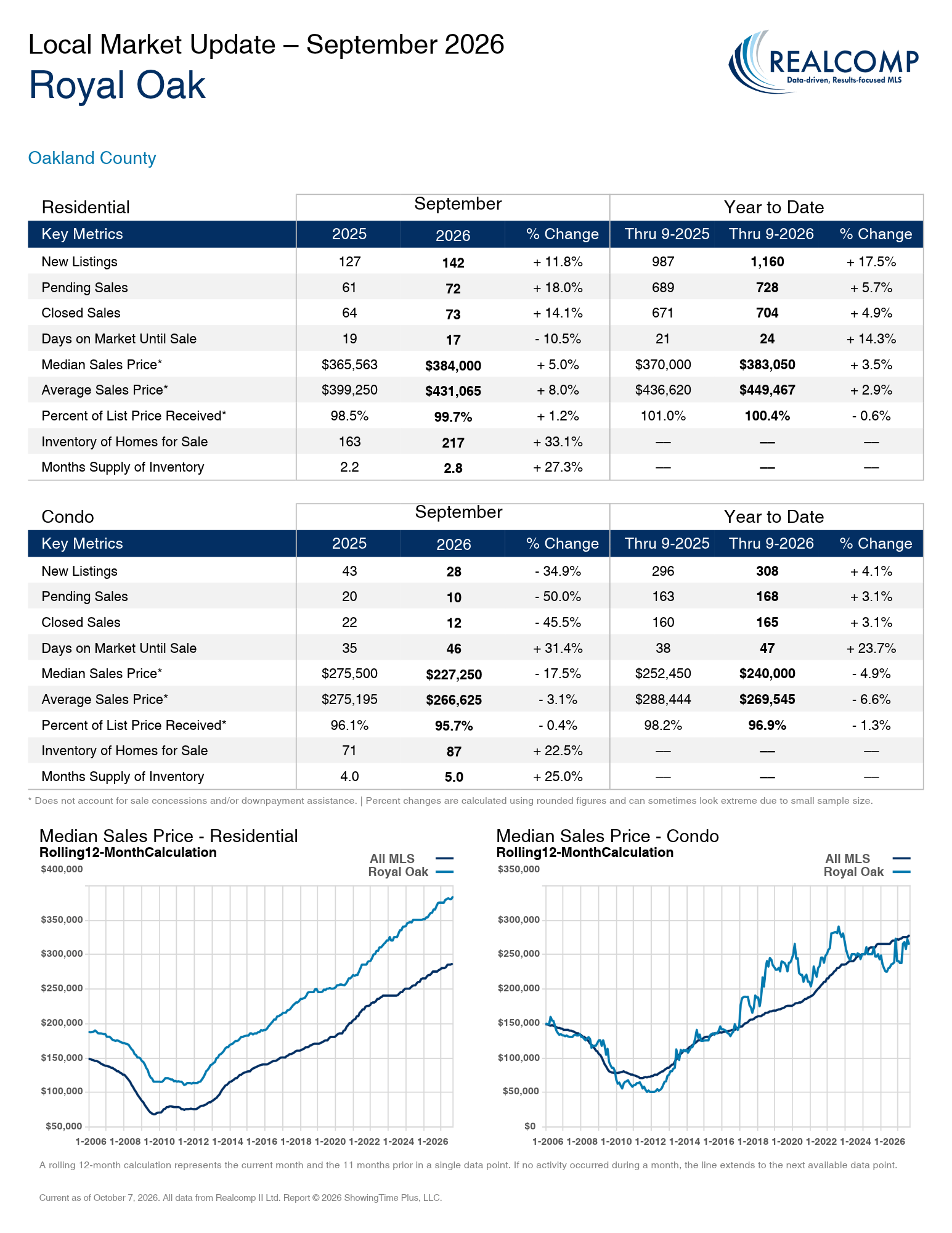
September 2026 Royal Oak housing market statistics showing residential and condo inventory, home prices, sales activity, days on market and months supply.
SOURCE: Realcomp II Ltd. — September 2026 Local Market Update, current as of October 7, 2026.
And Royal Oak Condos Prove Why There Are Markets Within Markets
There isn't even one Royal Oak market.
Royal Oak condos experienced something very different during September.
Condo inventory increased 22.5% year over year.
Months supply increased from 4.0 to 5.0 months.
Days on market increased from 35 to 46 days.
September's median condo sales price declined 17.5% year over year, while the year-to-date median was down 4.9%.
Realcomp also cautions that percentage changes can sometimes appear extreme because of small sample sizes. Royal Oak Sept 2026
Same city.
Same month.
Different property type. Different market experience.
That's why I will continue asking:
Which market?
Property type matters.
Price point matters.
Condition matters.
Competition matters.
Buyer demand matters.
And increasingly, how a property is prepared, priced and positioned matters.
The Bigger Money Story Is Equity
WATCH: The Market Is Slowing. So Why Are Metro Detroit Home Values Still Growing?
Your Home Isn't Only a Transaction
This is the part of the housing conversation I think gets lost.
We watch real estate in tiny increments.
What happened this week?
What happened this month?
Did rates move?
Did inventory increase?
Did another listing reduce its price?
Did that house sit for 30 days?
All of those things matter when you're actively buying or selling.
But if you've owned a home for five, ten, fifteen or twenty years, there's another story happening.
You've been holding an asset.
And depending on when and where you purchased, that asset may have appreciated considerably over time.
At the same time, homeowners with mortgages may have been reducing their loan balance with each principal payment.
The difference between what the property is worth and what is owed against it is equity.
And that equity can become significant.
That's money.
Not necessarily cash sitting in a checking account.
But value you've built inside an asset.
If you're wondering where that value begins, What Is My Home Worth in Royal Oak, Michigan? explains why determining current market value is more nuanced than simply looking at an automated estimate or a neighbor's sale.
Understanding current value is the first part of understanding equity.
Real Estate Doesn't Move in a Straight Line
This is important.
I'm not going to tell homeowners that real estate only goes up.
It doesn't.
Markets cycle.
Values can decline.
Different cities perform differently.
Different property types perform differently.
Economic conditions change.
And as the September Royal Oak condo numbers demonstrate, even two property types within the same city can experience very different conditions at the same time. Royal Oak Sept 2026
But that's also why I think perspective matters.
A homeowner who has held real estate for years shouldn't necessarily evaluate the performance of that asset based solely on what happened during the last two weeks.
The rolling 12-month residential median-price chart included with Realcomp's September Royal Oak report shows periods of decline and recovery across a much longer timeline—not a perfectly straight climb. Royal Oak Sept 2026
Long-term ownership and today's selling conditions are two different conversations.
And understanding the difference matters.
Equity Creates Options
This is where the conversation becomes much bigger than:
“What can I sell my house for?”
Equity can create choices.
For one homeowner, selling may allow them to carry substantial equity into their next home.
For another, it may allow them to reduce how much they need to finance.
Someone preparing to downsize may discover that years of accumulated equity materially change what their next chapter can look like.
And over longer periods of ownership, real estate can become part of the wealth a family builds and potentially transfers from one generation to another.
That's part of why homeownership has such an important place in conversations about long-term wealth.
But I think the phrase “generational wealth” sometimes gets thrown around without explaining what it actually means.
It isn't magic.
It isn't guaranteed.
And it isn't created because someone owned a house for six months and the market went up.
It's created over time through ownership, appreciation when it occurs, debt reduction, good financial decisions and ultimately what an owner chooses to do with the asset they've built.
Real estate can become part of a family's financial foundation.
And sometimes homeowners don't realize how much of that foundation they've already built.
Your Equity Doesn't Mean Today's Buyer Will Overpay
This is the other side of the conversation.
You may have substantial equity.
Your home may be worth considerably more than what you originally paid for it.
That does not mean today's buyer owes you whatever number you want.
Equity is about your ownership position.
Market value is about what today's market supports.
Those are different things.
And when buyers have more inventory to choose from, sellers have less room for sloppy positioning.
That's why I care so much about HOW a property enters the market.
HOW is it prepared?
HOW is it presented?
HOW is it positioned against its competition?
HOW is it priced?
HOW is it marketed?
HOW are buyers responding?
Those questions matter more when buyers have choices—not less.
Because today's buyer can compare your home with everything else available to them.
And they will.
Buyer Response Still Determines What Happens Next
A seller can believe a home is worth $500,000.
Comparable sales can suggest a range.
An automated valuation can produce another number.
But once the property enters the market, something important happens:
The actual market meets the actual house.
That's when buyer behavior starts giving us information.
Are buyers seeing it?
Are they engaging with it?
Are they saving it?
Are they scheduling showings?
Are they coming back?
Are they writing?
That's why How Do Buyers Decide What to Offer on a Royal Oak Home? matters in a market where buyers have more choices.
Buyers aren't responding to price in isolation.
They're responding to the entire experience:
Preparation. Presentation. Price. Competition. Perceived value. Demand.
And then they decide whether to act.
Prepare. Present. Position. Market. Create demand. Evaluate. Negotiate. One strategy.
The Signature by Lisa Perspective
I don't think sellers need someone to tell them:
“Don't worry. The market is great.”
That's not useful.
The market has slowed.
Buyers have more choices.
Some properties are taking longer to sell.
Some sellers are adjusting prices.
Some property types are experiencing considerably more pressure than others.
That's the market we're working in.
But I also don't think homeowners should hear those facts and automatically conclude:
“My home must be losing value.”
“The market is crashing.”
“I missed my opportunity.”
“My equity is disappearing.”
The September data doesn't support making those blanket assumptions.
What it supports is a more nuanced conversation.
What's happening in your market?
What is your home worth today?
How much equity have you built?
What is competing against you?
What would you need to do to position your home effectively in today's market?
And perhaps most importantly:
What could the equity you've already built allow you to do next?
That's a much more useful conversation than trying to predict the next scary housing headline.
The Next Question: What Is Your Equity Position?
For many homeowners, knowing an estimated market value is only the beginning.
The bigger question is:
What does that value mean for you?
If your property is worth substantially more than when you purchased it, understanding your approximate equity can help you evaluate your next move with much more clarity.
Selling.
Downsizing.
Moving into another community.
Using equity toward the next purchase.
Or simply understanding the financial position you've built without making a move at all.
And if the question becomes whether today's changing market should affect the timing of that move, Should I Sell My Royal Oak Home Now or Wait Until 2027? takes that decision one step further.
You don't have to be ready to sell to understand your equity.
And I think more homeowners should know what they've built.
Frequently Asked Questions
Does a slowing housing market mean home prices are falling?
Not necessarily. A slowing housing market can include more inventory, fewer transactions, longer market times or greater buyer negotiating power without automatically causing home values to fall. September 2026 Oakland County residential inventory increased 20.4% year over year while the median residential sales price increased 2.5%.
Are Metro Detroit home values still increasing in 2026?
Market performance varies by location and property type. In September 2026, Oakland County's median residential sales price increased 2.5% year over year, while Royal Oak's median residential sales price increased 5.0%. Other segments, including Royal Oak condos, experienced different price trends.
Is the Metro Detroit housing market slowing down?
Some September 2026 indicators show a slower market, including increased Oakland County inventory, fewer pending sales and fewer closed sales compared with September 2025. However, conditions vary by community, property type, price point, condition and buyer demand.
Why can inventory rise while home values also rise?
Inventory measures how many homes are available, while home values are influenced by multiple factors including buyer demand, location, property type, condition, competition and the prices buyers are willing to pay. More inventory can give buyers additional choices without automatically causing values to decline.
What is home equity?
Home equity is generally the difference between a property's current market value and the amount still owed against it. Equity can grow through appreciation when property values increase and through reduction of the mortgage principal over time.
Can real estate help build generational wealth?
Real estate can be one component of long-term family wealth. Over time, property ownership may allow an owner to build equity through appreciation and mortgage principal reduction, and that asset may eventually be sold, reinvested or transferred. Real estate values are not guaranteed to increase, and market performance varies by property and location.
How do I know how much equity I have in my home?
Understanding approximate home equity starts with estimating the property's current market value and comparing it with the outstanding balances secured by the property. A local market review can help establish a more informed estimate of current value before calculating an approximate equity position.
Conclusion
Yes. The market is slowing.
That isn't something I need to spin.
Buyers have more choices.
Inventory has increased.
Some sales activity has softened.
Some properties are taking longer to sell.
But that's only one side of the story.
Slower does not automatically mean falling values.
And it certainly doesn't erase the equity homeowners may have spent years building.
September's numbers give us a clear example.
Oakland County inventory increased more than 20% year over year while its median residential sales price still increased 2.5%. Oakland County Sept 2026
Royal Oak residential inventory increased more than 33%, while its September median sales price increased 5%. Royal Oak Sept 2026
And Royal Oak condos experienced something entirely different.
Markets within markets.
So I'm not ignoring the slowdown.
I'm interpreting it.
Because the question isn't simply:
“Is the market slower?”
It is.
The better questions are:
What is happening to value?
What is happening in your specific market?
How much equity have you built?
And if you're considering a move:
How do we protect that equity by preparing, pricing and positioning your home correctly for the market we're actually in?
Closing Thoughts
Housing headlines tend to measure the market in days, weeks and months.
Homeownership is measured in years.
That's an important distinction.
Real estate doesn't move in a straight line.
But a slower October doesn't suddenly erase what a homeowner may have built over five, ten, fifteen or twenty years.
The market can slow.
Buyers can gain choices.
Negotiations can change.
And homeowners can still be holding substantial equity.
All of those things can be true at once.
The first step is understanding your numbers.
How Much Equity Have You Built in Your Home?
You don't need to be ready to put a sign in the yard to understand the financial position you've built through your home.
If you've owned your property for several years and you're wondering what it's worth today, how much equity you may have, or what that equity could make possible for your next move, let's take a look at the numbers together.
I'll review your property, relevant recent sales and current competition to help you understand an estimated current market value and what that may mean for your equity position.
This isn't about pushing you to sell. It's about giving you clarity around one of your largest assets.
Let's Review Your Home Equity
REQUEST MY EQUITY REVIEW
About Lisa A. Mills
Lisa A. Mills is a REALTOR®, founder of Signature by Lisa, and is affiliated with National Realty Centers | Powered by JMG. She specializes in helping Metro Detroit homeowners confidently navigate life's transitions through strategic planning, local market expertise, and innovative digital marketing.
Known as The Calm Strategist When Life Shifts, Lisa believes selling a home begins with understanding—not assumptions. Through thoughtful preparation, strategic pricing, and a focus on buyer confidence, she helps homeowners make informed decisions that lead to stronger outcomes.