
Yes, some homes are taking longer to sell.
But I don't think the most useful question is simply:
“Why is the market slower?”
The better question is:
What changed about the way buyers are making decisions?
Because buyers didn't suddenly disappear.
What changed is the environment they're buying in.
Inventory has increased.
Buyers have more choices.
Affordability continues to affect what buyers can comfortably spend.
And when buyers have more choices, they have more opportunities to compare one property against another.
That changes buyer behavior.
A buyer who might have overlooked a dated kitchen, questionable pricing or a less-than-ideal presentation when there were very few homes available may make a completely different decision when five other homes are competing for their attention.
A slower market doesn't necessarily mean there isn't a buyer for your home.
It means you may have to earn that buyer's attention.
And for Metro Detroit sellers, that's an important distinction.
SECTION 1: What Changed in the Metro Detroit Housing Market?
Buyers Have More Choices
Let's start with what the September 2026 numbers are telling us.
In Oakland County, residential inventory increased from 2,511 homes in September 2025 to 3,024 homes in September 2026.
That's a 20.4% increase in inventory.
Months supply increased from 2.4 months to 2.9 months.
Pending sales declined 7.3% year over year, while closed sales declined 4.8%.
Days on market increased slightly from 24 to 25 days. Oakland County Sept 2026
Those numbers don't tell me buyers stopped buying.
They tell me the competitive environment changed.
There are more properties competing for buyer attention.
And when buyers have more choices, sellers have more competition.
That's different.
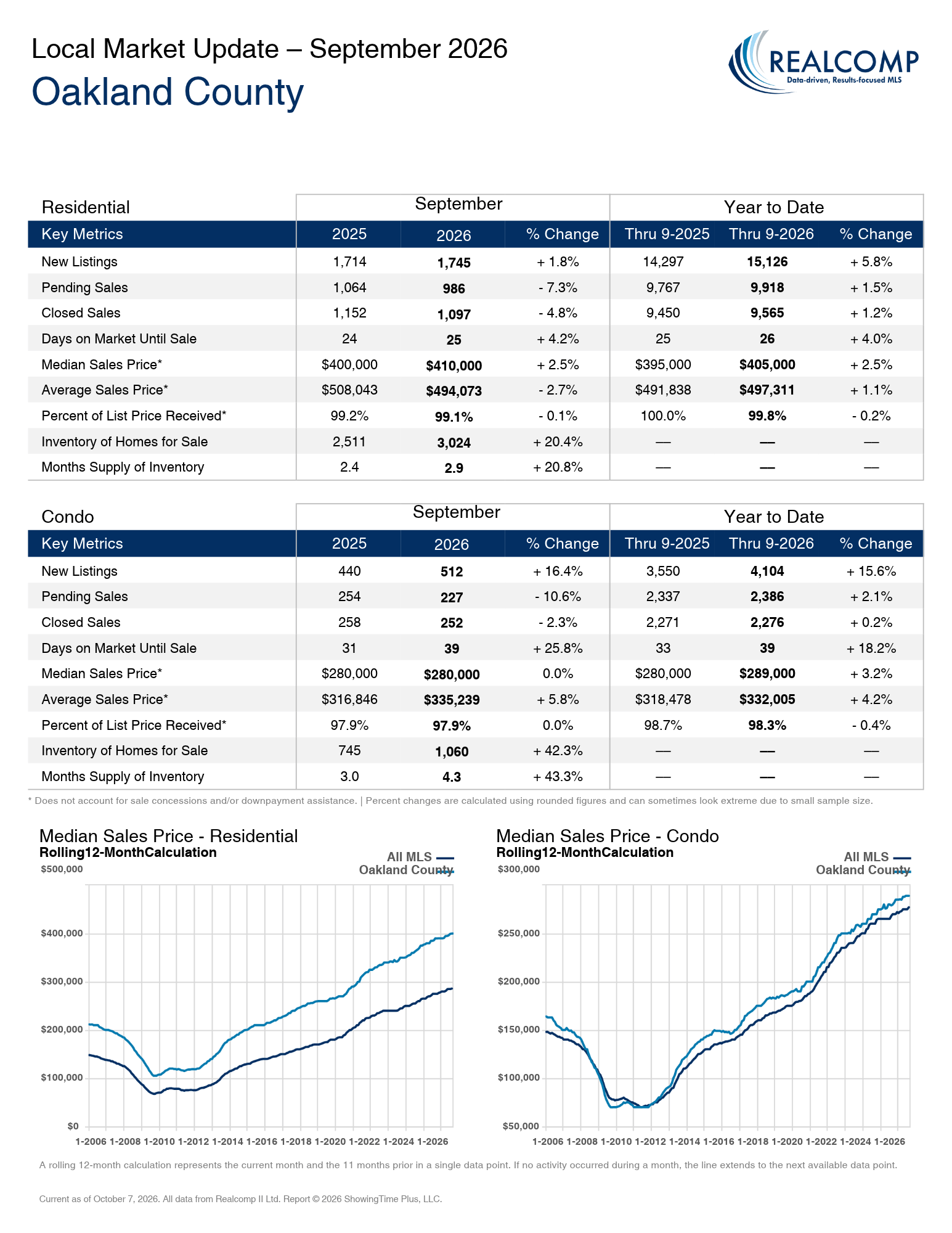
September 2026 Oakland County housing market statistics showing residential inventory, pending sales, closed sales, days on market, home prices and months supply.
SOURCE: Realcomp II Ltd. — September 2026 Local Market Update, current as of October 7, 2026.
But More Inventory Doesn't Affect Every Home the Same Way
This is where I think housing-market conversations become too broad.
We've already talked about this in Is the Metro Detroit Housing Market Depressed? What Sellers Need to Understand.
There isn't one Metro Detroit housing market.
There are markets within markets.
September's Royal Oak numbers are a good example.
Royal Oak residential inventory increased 33.1% year over year.
That sounds like a substantial slowdown signal.
But during that same month:
Pending residential sales increased 18.0%.
Closed sales increased 14.1%.
Days on market actually declined from 19 days to 17 days.
The median sales price increased 5.0%.
And the average sales price increased 8.0%. Royal Oak Sept 2026
So simply saying:
“Inventory is up, therefore homes aren't selling”
doesn't tell the whole story.
Some homes are selling.
Some are selling quickly.
Some are sitting.
And some are requiring price adjustments before buyers respond.
The more useful question is why.
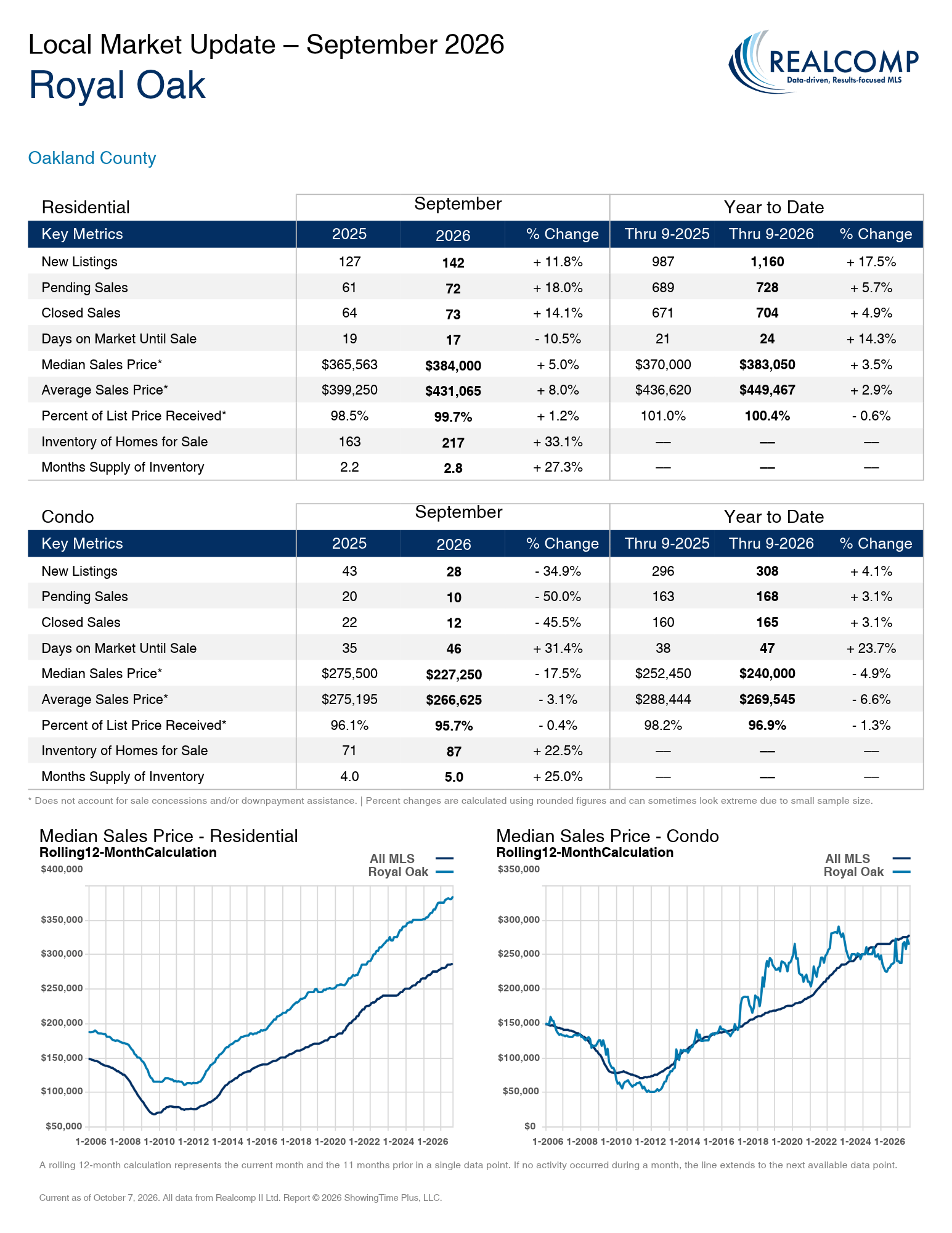
September 2026 Royal Oak housing market statistics showing residential and condo inventory, sales activity, days on market, home prices and months supply.
SOURCE: Realcomp II Ltd. — September 2026 Local Market Update, current as of October 7, 2026.
Slower Doesn't Automatically Mean Falling Values
This distinction matters enough that I addressed it directly in The Market Is Slowing. So Why Are Metro Detroit Home Values Still Growing?
A market can slow while home values remain resilient.
Market velocity and market value are not the same thing.
But this article is about the other side of that equation.
If buyers have more choices, what determines which homes they choose?
That's where this becomes a seller-strategy conversation.
SECTION 2: More Choice Changes Buyer Behavior
Buyers Can Compare Before They Commit
Think about the buying experience for a moment.
When inventory is extremely limited, a buyer may see a home that's reasonably close to what they want and feel pressure to act.
There may not be another comparable property available.
Waiting could mean losing the house.
Competition can create urgency.
Now change the environment.
Give that same buyer several reasonable alternatives.
They can compare kitchens.
Bedrooms.
Bathrooms.
Updates.
Location.
Taxes.
Lot.
Condition.
Presentation.
Price.
Monthly payment.
And overall perceived value.
The house isn't being evaluated by itself anymore.
It's being evaluated against the other choices available to that buyer.
That's why rising inventory matters even when home values haven't collapsed.
More inventory creates more comparison.
And more comparison creates more selectivity.
WATCH: Why Are Homes Taking Longer to Sell in Metro Detroit Right Now?
Coming Soon
Preparation Matters More When Buyers Can Compare
A home doesn't need to be completely renovated to sell.
But buyers need to understand what they're buying.
When buyers have alternatives, condition becomes part of the comparison.
A well-maintained home can feel easier to buy.
A property that appears to have deferred maintenance can create questions.
Sometimes those questions are manageable.
Sometimes they create uncertainty.
And uncertainty affects buyer confidence.
That's why preparation isn't simply about making a home look pretty.
Preparation helps reduce the number of unanswered questions a buyer has to work through before deciding to act.
Presentation Has to Match the Real-World Experience
Buyers often experience a property twice.
First online.
Then in person.
Photography, video, digital marketing and listing presentation help create the first impression.
But the second experience has to support the first.
If the online presentation creates one expectation and the in-person experience delivers something substantially different, buyer confidence can disappear quickly.
The goal isn't to make a home appear to be something it isn't.
The goal is to present the property authentically and strategically so the right buyer understands its value before they ever walk through the door.
Positioning Is More Than Putting a Price on the House
This is where sellers sometimes confuse price with positioning.
Price is part of positioning.
It isn't all of it.
Positioning asks:
What else can this buyer purchase?
If your home is $425,000, what are buyers seeing between $400,000 and $450,000?
What condition are those homes in?
What updates do they have?
How long have they been available?
Have they reduced their prices?
What are buyers responding to?
And where does your home fit inside that competitive set?
That's the market the property is actually entering.
Price Still Matters—But Price Doesn't Work Alone
A seller can price a home competitively and still have poor presentation.
A beautifully prepared home can still be overpriced.
Excellent marketing can't force buyers to perceive value that isn't there.
And reducing the price won't necessarily solve a problem that was actually caused by presentation, condition or a poor launch.
That's why strategy has to work together.
When a property enters the market, I'm looking at the entire buyer experience.
Preparation.
Presentation.
Positioning.
Price.
Marketing.
Competition.
Buyer response.
Not one isolated piece.
What Is the Market Telling You?
This is where sellers can get frustrated.
The home is online.
People are looking at it.
Maybe there have been showings.
Maybe there haven't.
Maybe buyers are saving it online but nobody is writing.
Maybe feedback sounds positive but nothing happens.
That's when the question becomes:
What does all of this actually mean?
I've created a simple resource for exactly that reason.
DOWNLOAD: What Is the Market Telling You?
A Seller's Guide to Reading Buyer Response

This guide helps sellers look at the signals that matter:
Exposure — Are buyers seeing the property?
Engagement — Are they clicking, viewing, saving or sharing it?
Showings — Is online attention turning into appointments?
Feedback — Are buyers repeatedly identifying the same concern?
Second Looks — Are buyers returning or disappearing after the first showing?
Offers — Are buyers willing to write, and what are the terms telling us?
Competition — What else can the same buyer purchase right now?
Price + Position — Is buyer behavior pointing toward an exposure problem, property problem, positioning problem or price problem?
Marketing creates exposure. The market tells us what that exposure means.
VA NOTE: Link the graphic/button to the downloadable PDF asset described in Item 2 below.
Views Without Offers Are Information
A listing receiving online attention but not converting into offers isn't necessarily experiencing a marketing failure.
In fact, exposure without action can tell us something very important.
Buyers may be seeing the property.
They may simply be deciding not to move forward.
That's why Why Your House Is Getting Views But No Offers is an important distinction.
Marketing's first job is to create exposure.
Once buyers are seeing the property, their behavior becomes information.
And our job is to interpret it.
No Showings Tells Us Something Different
A home receiving very little showing activity presents a different question.
Are buyers seeing it?
Is the photography creating enough interest?
How is it positioned against competing homes?
Is the price preventing buyers from putting it on the showing list?
That's why Why Is My House Not Getting Showings in Royal Oak, Berkley & Clawson, MI? addresses a different seller problem.
Those are older hyperlocal articles, but the buyer-behavior principles still apply.
Different signals require different responses.
An Offer Is Buyer Behavior Too
The same thing happens once offers begin arriving.
An offer isn't simply a number.
It's another piece of market information.
What is the buyer willing to pay?
What terms are they requesting?
How much risk is contained in the offer?
How strong is the financing?
How does the offer compare with the seller's priorities?
And what does it tell us about perceived value?
That's why I wrote How Do Buyers Decide What to Offer on a Royal Oak Home?.
The location of that article is Royal Oak, but the buyer behavior behind it applies across Metro Detroit.
Buyers respond to the entire property experience—not price alone.
The Signature by Lisa Perspective
I don't think a seller should panic because a home didn't sell in three days.
And I don't think the answer to every slower listing is:
“Reduce the price.”
Sometimes the market needs time to give us enough information.
Sometimes the marketing needs adjustment.
Sometimes presentation is creating friction.
Sometimes the competitive environment changed.
Sometimes buyer affordability is affecting the price range.
And yes—sometimes the market has already given us the answer and price is the problem.
The important part is knowing the difference.
That's why I don't like making listing decisions based solely on a calendar.
I want evidence.
What are buyers doing?
What aren't they doing?
What changed?
What patterns are developing?
What happened with competing properties?
And what is the market repeatedly telling us?
Because when we have enough information, the goal isn't to argue with the market.
The goal is to interpret it and decide what to do next.
The Next Question: When Should You Change the Price?
This is the natural next question.
If your home has been exposed to the market and buyers aren't responding, when does waiting stop being patience and start becoming lost momentum?
A price reduction shouldn't happen simply because a certain number of days passed.
It should happen because the evidence supports the decision.
That's the conversation in:
When Should I Reduce the Price of My Royal Oak Home?
The geography of that article is Royal Oak, but the strategy applies across Metro Detroit:
A price reduction shouldn't be triggered by the calendar. It should be triggered by evidence.
Frequently Asked Questions
Why are homes taking longer to sell in Metro Detroit right now?
More inventory is giving Metro Detroit buyers additional choices, which allows them more time to compare price, condition, location and perceived value before making a decision. The effect varies by city, property type, price point and competition, which is why some homes are still selling quickly while others are taking longer.
Are buyers still buying homes in Metro Detroit?
Yes. Buyers are still purchasing homes in Metro Detroit, but increased inventory can make them more selective. September 2026 data illustrates why the market cannot be described with one broad statement: Oakland County pending and closed residential sales declined year over year, while Royal Oak pending and closed residential sales increased.
Does more inventory make it harder to sell a home?
More inventory creates more competition for buyer attention. That does not mean a home cannot sell, but preparation, presentation, positioning, price and perceived value become increasingly important when buyers have multiple properties to compare.
Why is my house getting views but no offers?
Online views without offers can indicate that buyers are seeing the property but are not finding enough value or confidence to take the next step. Price, condition, presentation, competition and the in-person buyer experience should be evaluated before assuming the problem is simply a lack of exposure.
Why isn't my house getting showings?
Low showing activity can indicate several different issues, including price, online presentation, condition, competition or buyer demand within that specific market segment. The key is to evaluate how the property is being exposed and positioned against the alternatives buyers can currently purchase.
Should I reduce my price if my house isn't selling?
Not automatically. A price reduction should be based on evidence from buyer response, showing activity, feedback, competition and market conditions rather than simply the number of days a property has been listed.
Is now a good time to sell a house in Metro Detroit?
Whether now is a good time to sell depends on the homeowner's specific market, property, equity position, competition and reason for moving. A changing market does not affect every Metro Detroit home the same way, so the decision should begin with the homeowner's circumstances rather than a broad market headline.
Conclusion
Yes, some Metro Detroit homes are taking longer to sell.
Inventory has increased.
Buyers have more choices.
Affordability matters.
Competition matters.
And buyers have more opportunity to compare one property against another.
But that's not the same thing as saying:
“Homes aren't selling.”
They are.
The more useful question is:
Which homes are buyers choosing—and why?
That's where preparation matters.
Presentation matters.
Positioning matters.
Price matters.
Marketing matters.
And buyer response matters.
Because when buyers have more choices, sellers have less room for assumptions.
The market is communicating with us.
The job is to understand what it's saying.
Closing Thoughts
A slower market doesn't automatically require a seller to panic.
But it does require us to pay attention.
The days of assuming that simply putting a home on the MLS will create urgency are gone in many segments of the market.
Buyers are looking.
They're comparing.
They're making decisions.
And every click, showing, second look, piece of feedback—and every decision not to write—is giving us information.
Marketing creates exposure. The market tells us what that exposure means.
And once we understand the message, we can make a strategic decision about what happens next.
Not Sure What the Market Is Telling You About Your Home?
If your home is already listed and taking longer to sell—or you're preparing to sell and want to understand how your property would compete in today's Metro Detroit market—let's look at the evidence.
I'll review the property's current competition, price, positioning and buyer response and help you separate what feels frustrating from what the market is actually communicating.
You don't need another opinion. You need to understand what the buyer behavior is telling you.
Let's Review Your Seller Strategy
REQUEST A SELLER STRATEGY REVIEW
ABOUT LISA A. MILLS
Lisa A. Mills is a REALTOR®, founder of Signature by Lisa, and is affiliated with National Realty Centers | Powered by JMG. She specializes in helping Metro Detroit homeowners confidently navigate life's transitions through strategic planning, local market expertise, and innovative digital marketing.
Known as The Calm Strategist When Life Shifts, Lisa believes selling a home begins with understanding—not assumptions. Through thoughtful preparation, strategic pricing, and a focus on buyer confidence, she helps homeowners make informed decisions that lead to stronger outcomes.