
I think we're having an incomplete conversation about housing affordability.
Every time I turn on the news, read a housing market report or have a conversation about real estate, mortgage interest rates seem to dominate the discussion.
Interest rates are too high.
Buyers are waiting for rates to come down.
Homeowners don't want to give up their low mortgage rates.
And there's this underlying assumption that if mortgage rates come down, housing will suddenly become affordable again.
I'm not convinced it's that simple.
Because when we step back and look at mortgage interest rates from a historical perspective, something interesting emerges.
Mortgage rates in the 6% to 8% range are not a new phenomenon.
We've been here before.
We've also experienced periods when interest rates were considerably higher.
What has changed is the financial environment surrounding homeownership.
The price of purchasing a home.
The cost of insuring it.
The property taxes associated with owning it.
The cost of maintaining it.
And the amount of household income required to sustain all of those expenses.
Here's where I think we need to shift the conversation:
The cost of borrowing money and the cost of owning a home are two very different things.
And if we're going to have a meaningful conversation about housing affordability in Metro Detroit heading into 2027, we need to talk about both.
Are Mortgage Interest Rates Really Historically High?
Let's start with some historical perspective.
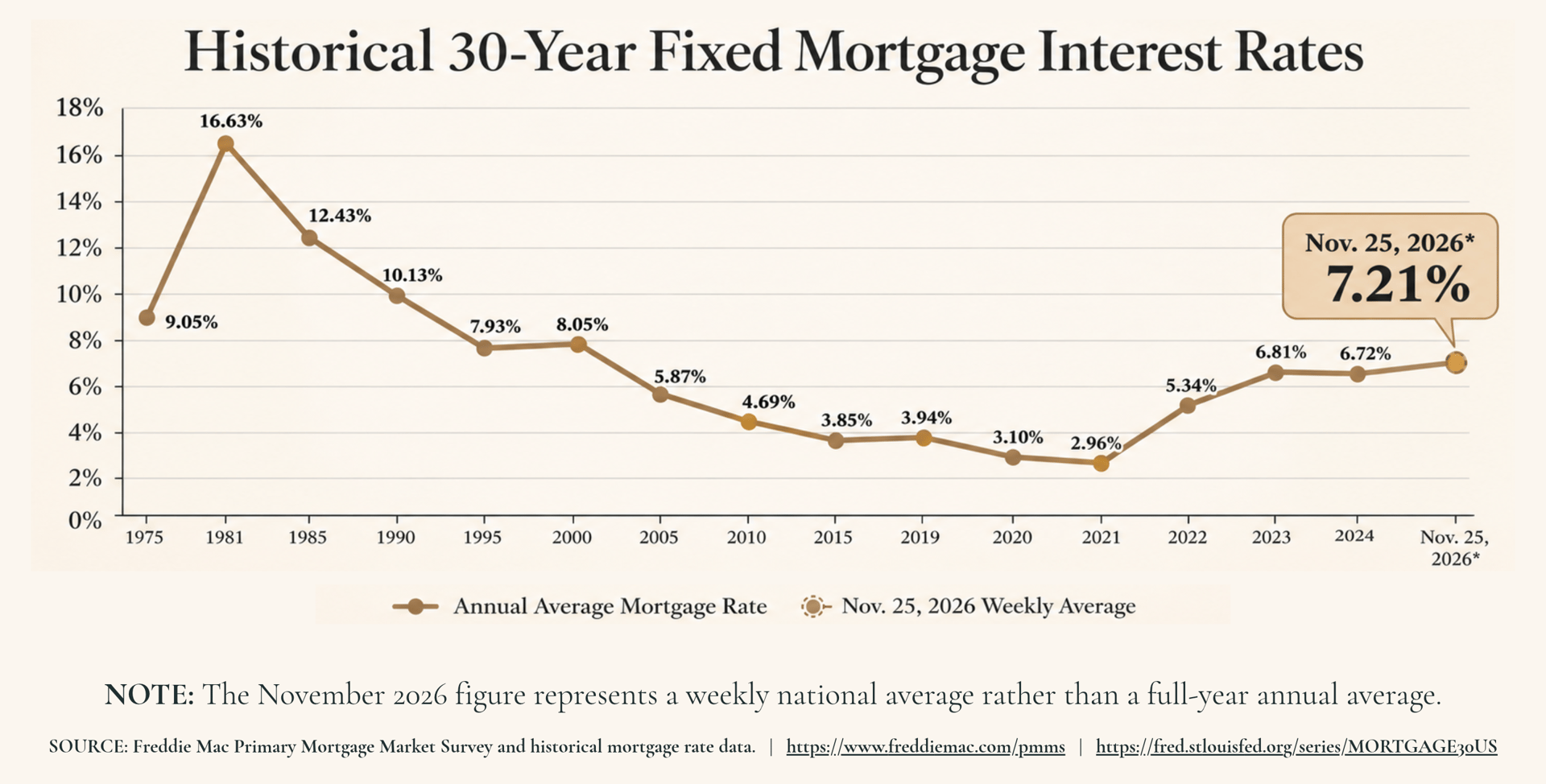
On November 25, 2026, Freddie Mac reported that the national average interest rate on a 30-year fixed-rate mortgage was 7.21%.
Compared with the rates many homeowners secured during 2020 and 2021, that sounds high.
But what happens when we expand our historical perspective beyond the past six years?
Historical United States 30-year fixed mortgage interest rates from 1975 through November 2026 showing interest rates above 16 percent in 1981 and historically low rates during 2020 and 2021.
What Does This Historical Perspective Tell Us?
In 1981, the annual average mortgage interest rate exceeded 16%.
Throughout portions of the 1980s and 1990s, double-digit mortgage interest rates were a reality for American homebuyers.
In 2000, the average mortgage rate was above 8%.
People bought homes.
People sold homes.
Families relocated.
Homeowners built equity.
Real estate transactions continued to happen.
That doesn't mean those periods were easy for homebuyers. And it doesn't mean today's affordability challenges aren't real.
It simply means that mortgage rates around 7% are not unprecedented.
They're higher than the rates consumers experienced for much of the past two decades, but they are well within the range experienced over the broader history of American homeownership.
The more unusual period was when mortgage interest rates fell to approximately 3% and, at times, even lower.
And I think that period fundamentally changed consumer expectations.
Did Historically Low Mortgage Rates Change Our Perception of Housing Affordability?
Think about what happened during 2020 and 2021.
Mortgage interest rates reached historically low levels.
Borrowing money became less expensive.
Buyers could potentially qualify for larger mortgages without experiencing the same increase in their monthly principal and interest payments.
But housing supply was limited in many communities.
The pandemic changed where and how people wanted to live.
Demand shifted.
Competition intensified.
Home prices increased significantly in many housing markets.
Low mortgage rates helped support purchasing power, but they were not the only factor influencing home prices. Housing supply, demographic changes, household preferences and buyer demand also played important roles.
Fast-forward to 2026.
Mortgage rates have moved higher.
But home prices haven't universally returned to their pre-pandemic levels.
That distinction matters.
Today's buyers are not simply borrowing money at rates that previous generations experienced.
They're frequently borrowing against much higher purchase prices.
The Same Interest Rate Does Not Equal the Same Monthly Payment
Consider two hypothetical home purchases using the same 7% mortgage interest rate, a 30-year loan and a 20% down payment.
The interest rate hasn't changed.
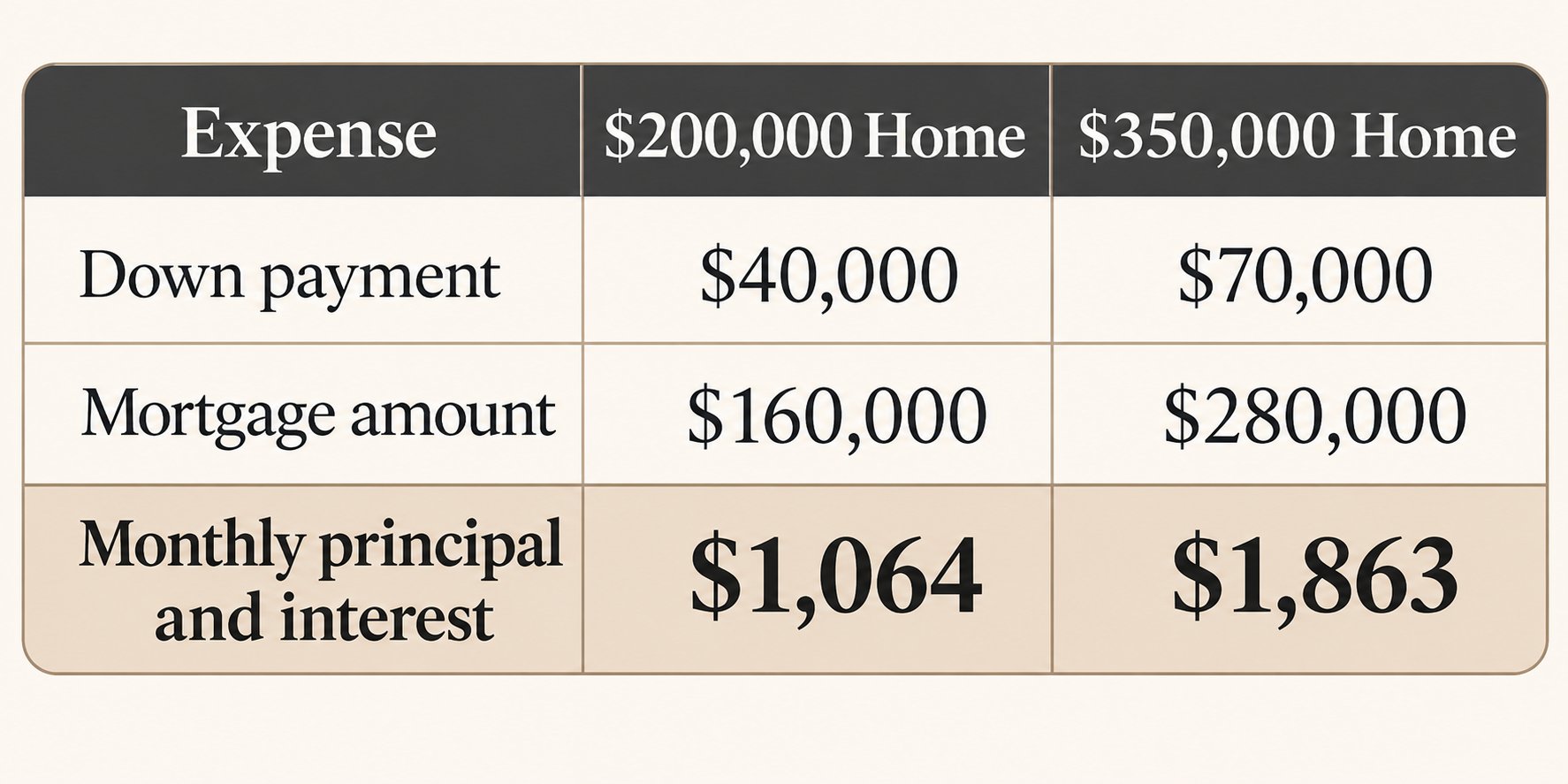
But the monthly principal and interest payment has increased by approximately $799.
And the buyer needs an additional $30,000 for the down payment.
Before we've even discussed insurance.
Before property taxes.
Before repairs.
Before utilities.
Before maintaining the home.
This is why comparing today's mortgage rates with historical mortgage rates without also considering home prices and household income only tells part of the story.
A household's ability to afford a home depends on the relationship between income, purchase price, borrowing costs and ongoing expenses.
The Rising Cost of Homeownership Isn't Just a Mortgage Problem
(Coming Soon)
WATCH: Why Is Housing So Unaffordable in Metro Detroit? Mortgage Rates Are Only Part of the Story
The Numbers Tell an Important Story
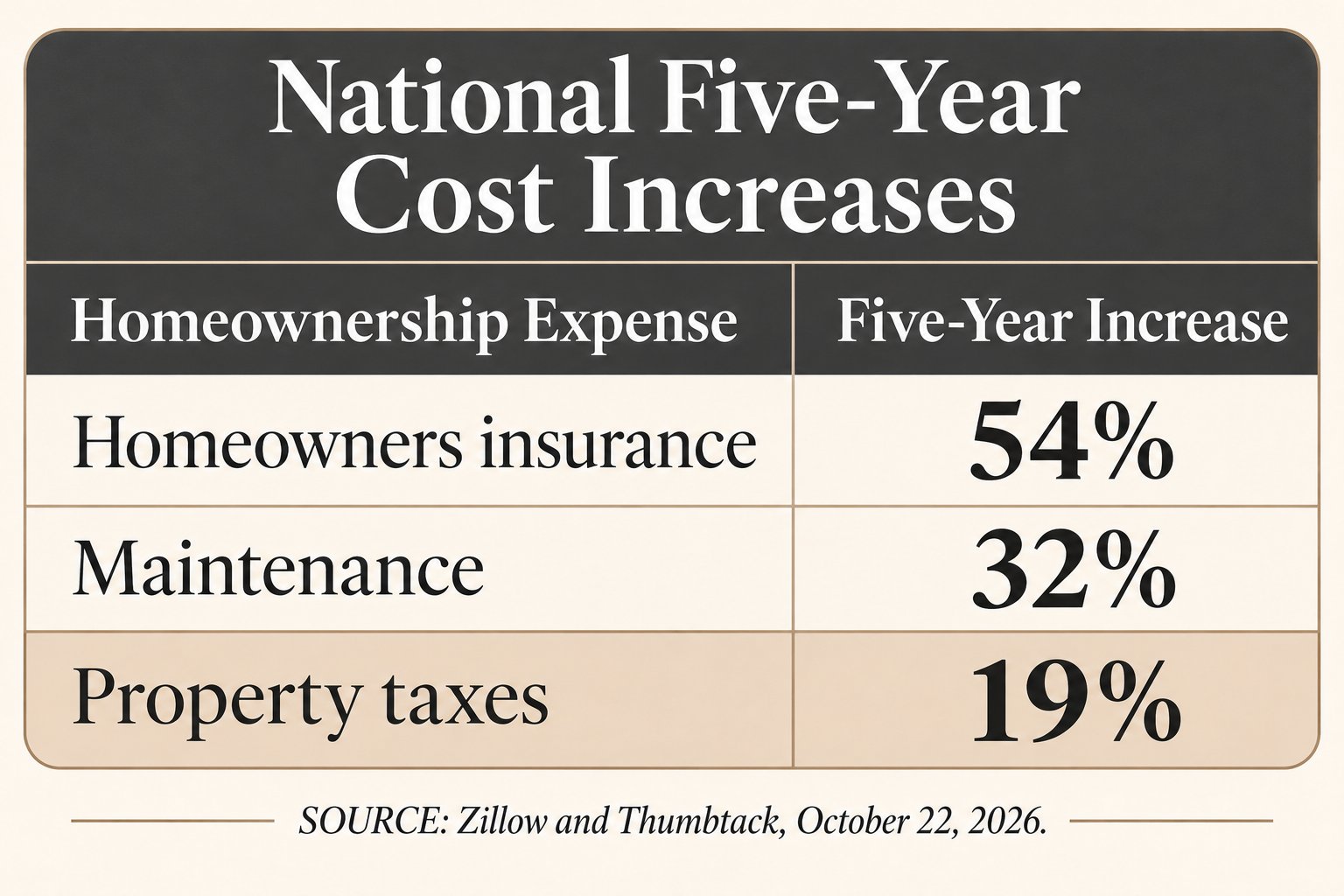
On October 22, 2026, Zillow and Thumbtack released an analysis examining three significant recurring homeownership expenses: maintenance, homeowners insurance and property taxes.
Their research estimated that these expenses now total approximately $16,566 annually for a typical American homeowner.
That's approximately $1,380 per month, separate from mortgage principal and interest.
Five-year national increases in homeownership expenses showing homeowners insurance up 54 percent, maintenance up 32 percent and property taxes up 19 percent according to October 2026 Zillow and Thumbtack research.
Here's what makes this conversation particularly important.
These expenses aren't limited to people purchasing a home today.
They affect existing homeowners, too.
You could have purchased your home in 2020.
You could have refinanced at 2.75%.
You could have avoided moving because you didn't want to give up that low mortgage rate.
And your overall cost of living in that home could still have increased considerably.
A fixed-rate mortgage fixes the interest rate and scheduled principal and interest payment.
It does not fix the cost of homeownership.
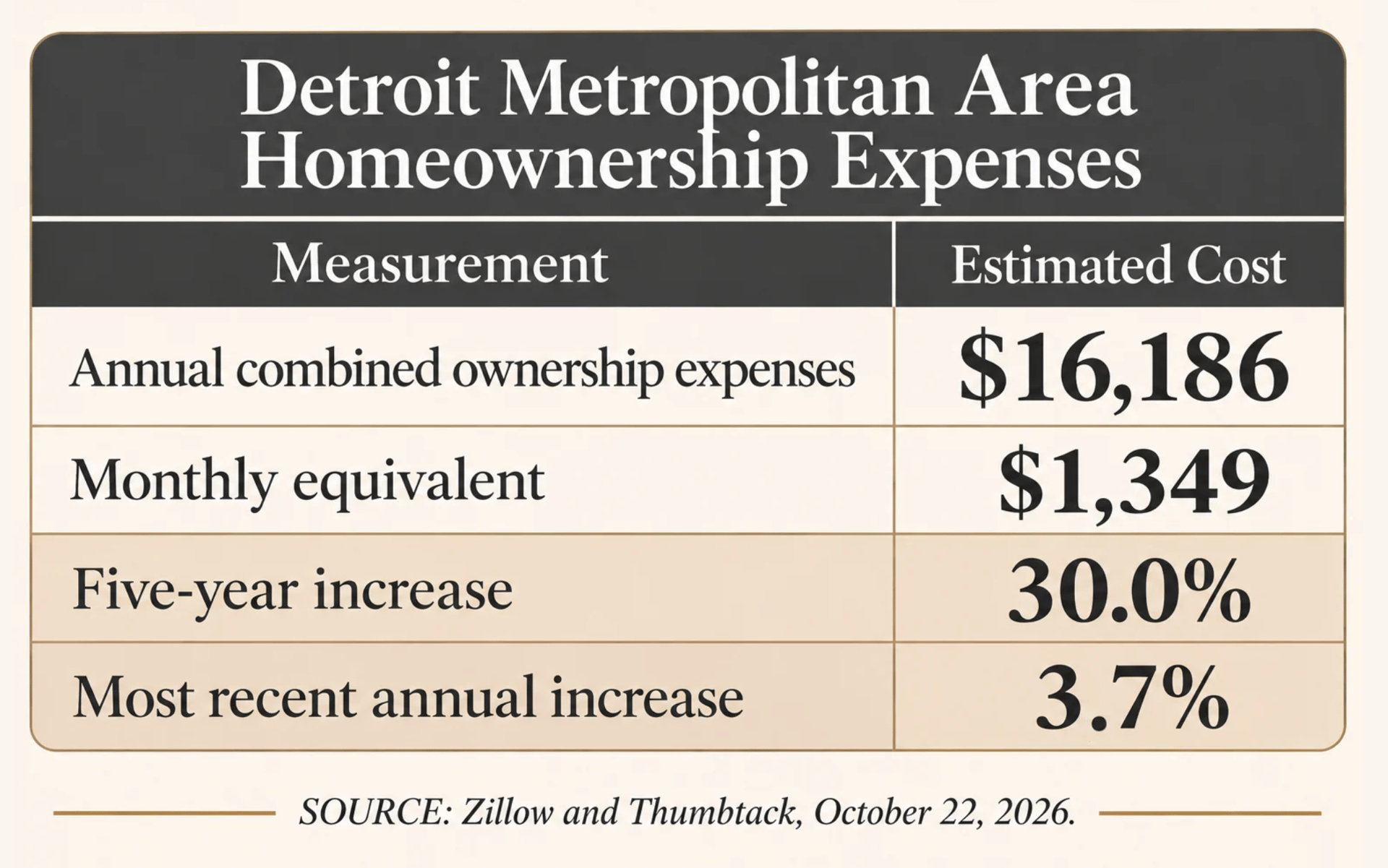
Estimated Detroit metropolitan area annual homeownership expenses of $16,186 for maintenance, property taxes and insurance, representing a 30 percent increase over five years as reported in October 2026.
These figures combine estimated maintenance, homeowners insurance and property taxes. They exclude mortgage principal and interest.
They are metropolitan-area estimates rather than actual expenses for every individual homeowner.
Why These Expenses Matter
Metro Detroit is a diverse housing market.
A bungalow in Berkley.
A ranch in Royal Oak.
A condominium in Birmingham.
A larger colonial in Oakland County.
Each property carries a different financial responsibility.
Older homes may require significant investment in roofs, plumbing, electrical systems, furnaces, windows and foundations.
Larger homes may carry higher heating, cooling and maintenance expenses.
Condominiums may reduce some individual maintenance responsibilities but introduce association dues and potential special assessments.
Property taxes vary by municipality, taxable value, millage rates and applicable exemptions.
Insurance costs vary by property characteristics, claims history, coverage and the insurance provider.
Two homes with identical purchase prices can have significantly different monthly ownership costs.
And those differences matter when determining what a household can actually afford.
Michigan Property Taxes — What Homeowners and Buyers Need to Understand
Michigan has a particularly important piece of the affordability conversation that often gets overlooked.
Proposal A.
Under Michigan's property tax system, annual taxable value increases are generally restricted to the lesser of 5% or the applicable inflation rate, with exceptions for additions and losses.
However, when a qualifying transfer of ownership occurs, that limitation is generally removed in the following calendar year and taxable value is reset to the property's state equalized value.
This is commonly referred to as uncapping.
Certain transfers are exempt, so the type of ownership transfer matters.
SOURCE: Michigan Department of Treasury, Changes in Ownership and Uncapping of Property.
The Seller's Property Tax Bill May Not Be the Buyer's Property Tax Bill
Consider a hypothetical homeowner who has owned a Metro Detroit property for 20 years.
During that time, the property's market value has increased substantially.
But annual limitations on taxable value increases may have kept the taxable value considerably below the property's current state equalized value.
When that homeowner sells, the incoming buyer may experience a substantially different property tax obligation after uncapping.
Hypothetical Michigan Property Tax Example
For illustration, assume the same applicable millage rate of 35 mills and no change in exemptions.
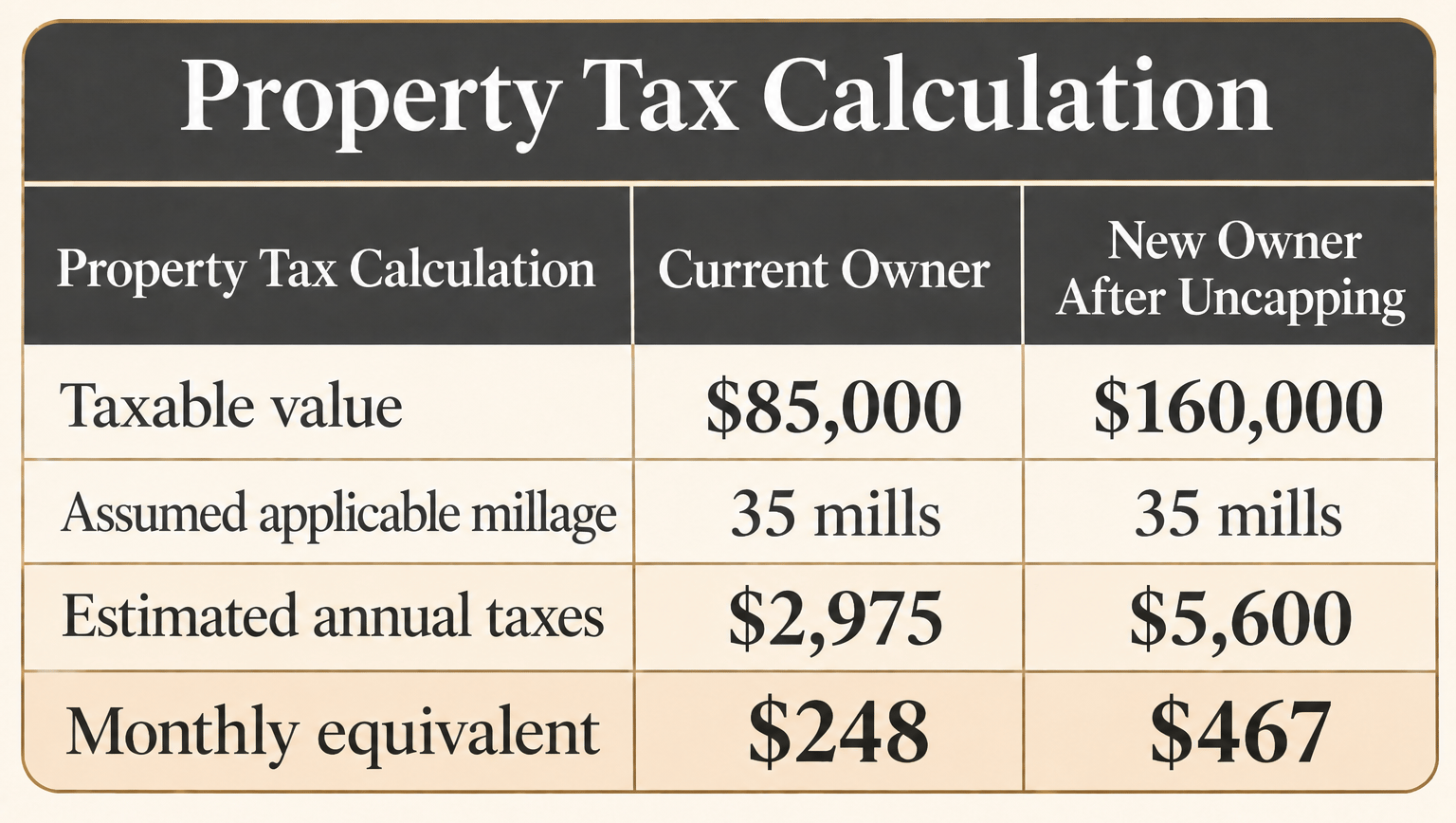
That's approximately $219 more per month in property taxes.
Same property.
Same assumed millage rate.
Different taxable value.
Actual taxes depend on assessments, millage rates, exemptions and other property-specific factors. Buyers should verify projected taxes with the local assessing office or Michigan's official property tax estimation resources.
Why This Also Matters to Sellers
If you're selling your home, buyers aren't necessarily evaluating the property based on what it currently costs you to own.
They're evaluating what it will cost them.
Your mortgage interest rate doesn't generally transfer to the buyer.
Your homeowners insurance premium may not reflect what the buyer will pay.
Your current property tax obligation may not reflect the buyer's future tax obligation.
That means two people can look at the same house and experience very different ownership costs.
And this becomes increasingly important when buyers are comparing multiple properties within the same price range.
Why Homeowners Insurance Deserves More Attention
Insurance is another component of homeownership that I think deserves a much larger place in the affordability conversation.
Unlike a fixed mortgage interest rate, homeowners insurance premiums can change when a policy is renewed.
Replacement costs, construction materials, labor expenses, property condition, claims experience, regional risks, coverage decisions and developments within the insurance industry can all influence premiums.
A homeowner who purchased years ago may have built a household budget around insurance costs that no longer reflect today's expenses.
Insurance Increases Affect Existing Homeowners, Too
Consider a homeowner who previously paid $1,500 annually for homeowners insurance and now receives a renewal premium of $2,400.
That's an additional $900 annually, or $75 per month.
Now combine that with an increase in property taxes.
An increase in maintenance expenses.
Higher utility costs.
Potentially higher association dues.
Individually, these increases may appear manageable.
Collectively, they can create meaningful pressure on household cash flow.
And if those expenses are included in a mortgage escrow account, a homeowner may experience an increase in their total monthly mortgage payment even though their mortgage interest rate hasn't changed.
The mortgage rate remains fixed.
The other costs do not.
The Real Cost of Owning a Home
Let's bring all of these expenses together.
The following hypothetical examples illustrate how purchasing a more expensive property, combined with higher ownership expenses, can affect a household's monthly budget even when the mortgage interest rate is identical.
Comparing Two Homeownership Budgets
Both examples assume a 30-year mortgage, 20% down and a 7% fixed interest rate.
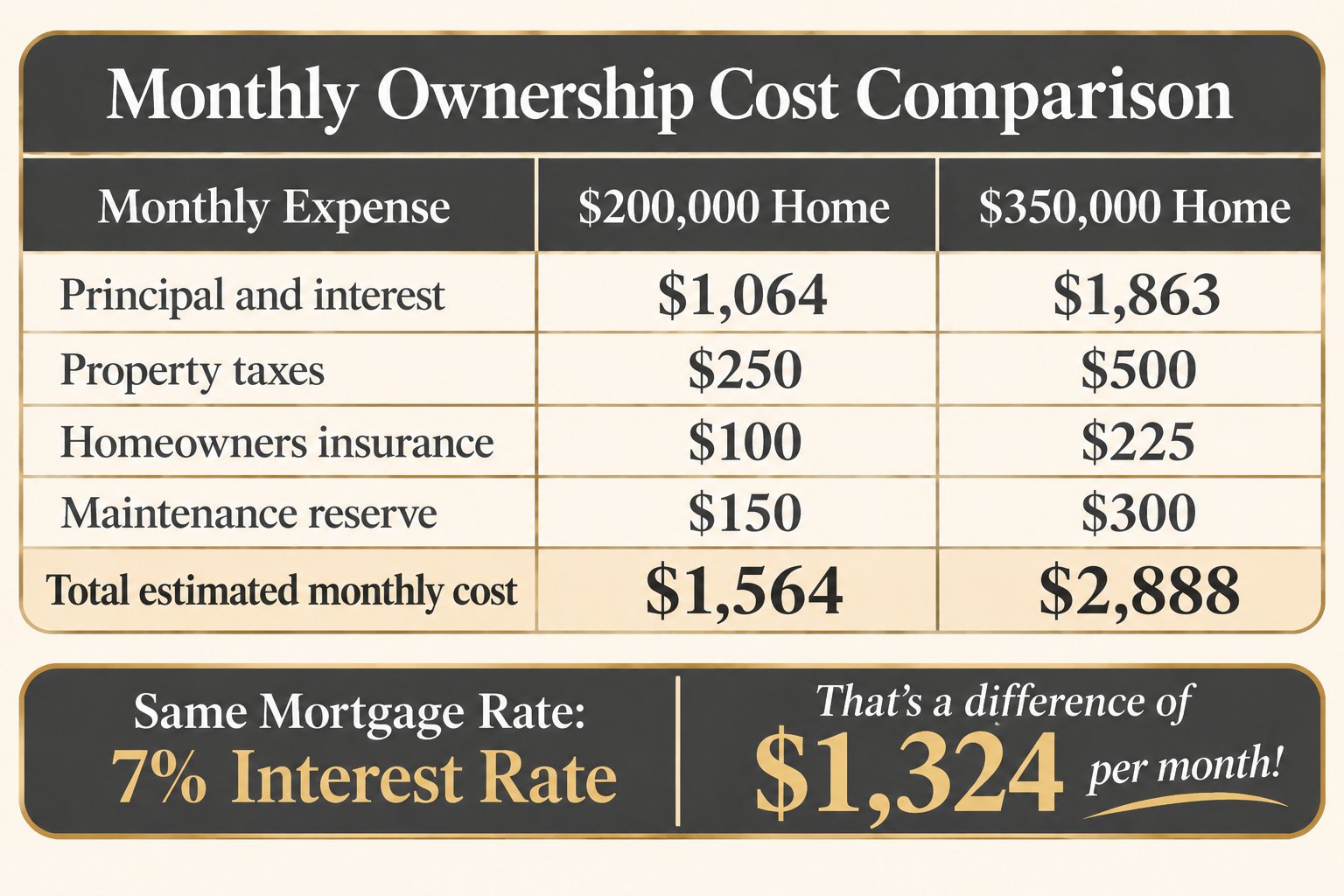
Comparison of estimated monthly homeownership expenses for a $200,000 home and a $350,000 home with identical 7 percent mortgage interest rates, showing the effects of higher purchase prices, taxes, insurance and maintenance. These examples are illustrative rather than historical averages or actual property-specific quotes.
The difference?
Approximately $1,324 per month.
Or $15,888 annually.
And neither example includes utilities, association dues or other household expenses.
What If Mortgage Rates Come Down?
Suppose the buyer purchasing the $350,000 property receives a 6% mortgage interest rate instead of 7%.
The monthly principal and interest payment on the $280,000 loan would decrease from approximately $1,863 to $1,679.
That's approximately $184 in monthly savings.
That matters.
But the property taxes, insurance and maintenance expenses haven't automatically decreased.
And if lower mortgage rates contribute to increased buyer demand without a corresponding increase in housing supply, prices could face additional upward pressure.
That outcome isn't guaranteed.
But it's another reason why lower mortgage interest rates alone may not resolve every aspect of housing affordability.
What Does Housing Affordability Mean for Homeowners Going Through Divorce?
This is where the affordability conversation becomes particularly personal.
During a divorce, one of the most significant financial and emotional decisions may involve what happens to the marital home.
One spouse may want to keep it.
There may be children involved.
There may be a desire to maintain stability.
There may be emotional attachments to the house or neighborhood.
And there may be a very attractive existing mortgage interest rate.
I understand why homeowners want to hold on to those things.
But I also think it's important to separate the emotional decision from the financial reality.
Can You Afford the House on One Income?
Imagine a household with the following hypothetical monthly expenses:
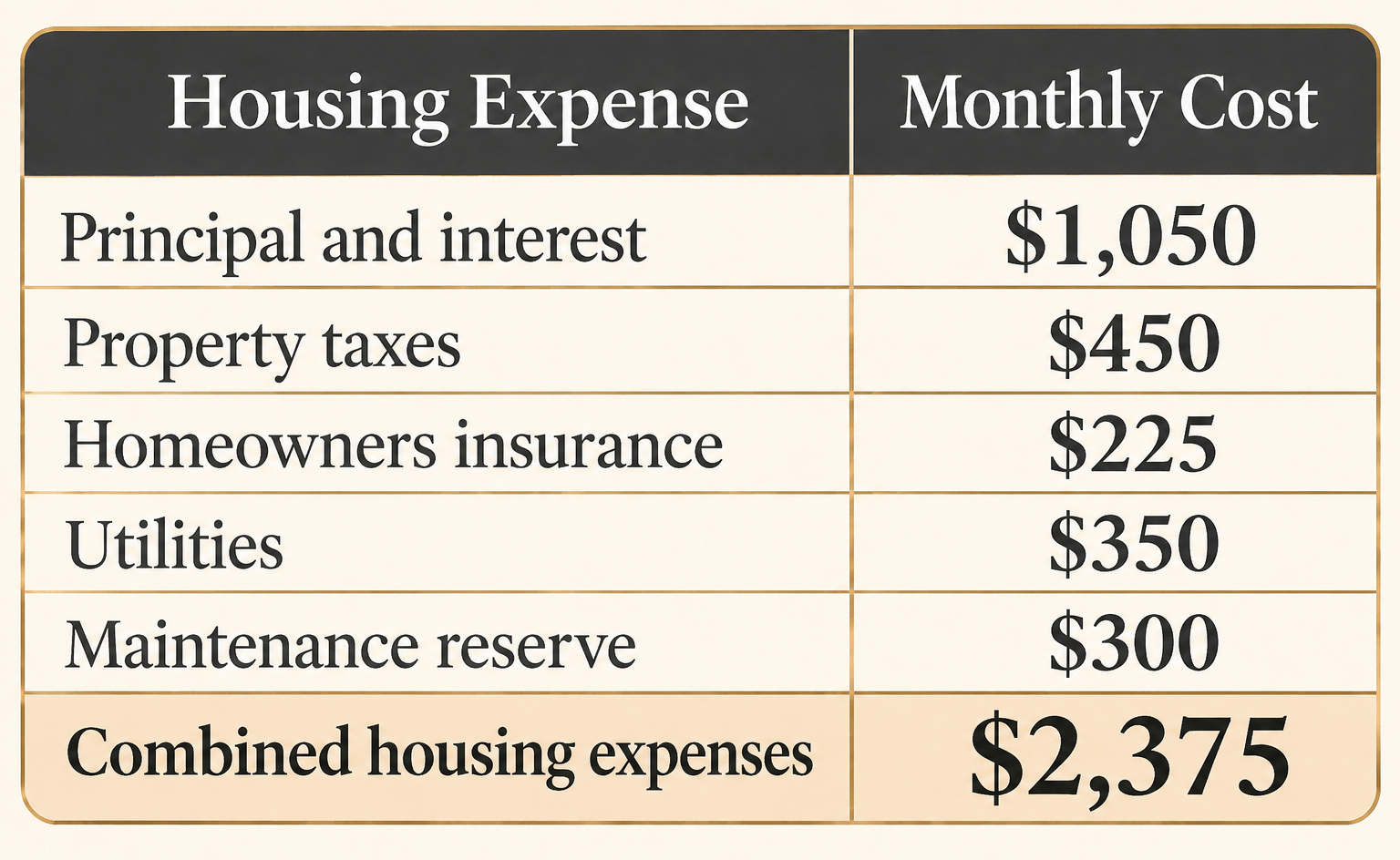
The household previously supported those expenses with two incomes totaling $9,000 per month before taxes.
The housing expenses represented approximately 26% of gross household income.
Now imagine one spouse remains in the home with a gross monthly income of $4,500.
Those same housing expenses now represent approximately 53% of gross monthly income.
The mortgage interest rate hasn't changed.
The property hasn't changed.
But the financial circumstances have changed significantly.
And this example doesn't include the potential need to refinance, compensate the other spouse for their share of equity, or address other divorce-related financial obligations.
A Low Mortgage Rate Is Valuable. But So Is Financial Stability.
A low interest rate may be financially advantageous.
But it should not be the only determining factor in whether someone keeps a home after divorce.
The more useful questions are:
What will it cost to maintain the home on one income?
Can the existing financing be retained under the proposed ownership arrangement?
Would a refinance or equity buyout be required?
How much money would remain available for emergencies, retirement and everyday living?
Is keeping the home financially sustainable over the next five or ten years?
What alternative housing options are available?
These questions deserve careful consideration alongside guidance from the appropriate legal, lending and financial professionals.
Keeping a home is not automatically the best financial decision.
Selling a home is not automatically the best financial decision, either.
The objective is to understand the financial implications before making either decision.
For homeowners facing disagreements about the marital property, my article, What Happens If One Spouse Refuses to Sell the House During a Divorce in Michigan?, explores another dimension of that decision.
For homeowners considering whether retaining the marital property is realistic, Can I Keep the House After Divorce in Michigan? provides additional perspective.
What Does Housing Affordability Mean for Metro Detroit Home Sellers?
If you're selling your home, understanding housing affordability isn't simply about watching mortgage rates.
It's about understanding the financial decisions buyers are making.
Buyers aren't shopping in a vacuum.
They're comparing properties.
They're comparing monthly payments.
They're considering property taxes.
They're getting homeowners insurance quotes.
They're evaluating the age of major mechanical systems.
They're thinking about whether a roof, furnace or central air conditioning system might need replacement.
They're determining how much money they will have remaining after closing.
And they're deciding whether a particular house justifies its total financial commitment.
Buyers Are Evaluating More Than the Asking Price
Two homes may both be listed for $325,000.
One may have a newer roof, updated mechanical systems and a lower projected tax obligation.
The other may have higher projected taxes and require significant improvements within the first few years of ownership.
From the seller's perspective, the homes may appear competitively priced.
From the buyer's perspective, they may represent substantially different financial commitments.
This is why preparation, presentation, pricing and positioning matter.
It's also why I encourage sellers to evaluate their property through the eyes of today's buyer rather than relying exclusively on what another homeowner received for a property several years ago.
My article, How Do Buyers Decide What to Offer on a Royal Oak Home?, explains how buyers evaluate perceived value, competition and purchase decisions.
The principles apply throughout Metro Detroit.
A successful sale begins with understanding what buyers are evaluating and how your property fits within their available choices.
What Should Buyers Be Looking at Heading Into 2027?
If you're considering purchasing a home, I would encourage you to begin with a different question.
Instead of asking:
“How much house can I qualify for?”
Ask:
“How much house can I comfortably afford to own?”
Those are not necessarily the same number.
Mortgage qualification is an important part of the process.
But it doesn't necessarily account for every expense that will affect your household's everyday financial flexibility.
Before purchasing a home in Metro Detroit, consider:
The estimated monthly principal and interest payment.
Projected property taxes following any applicable uncapping.
A property-specific homeowners insurance quote.
The age and condition of major mechanical systems.
Anticipated maintenance and repair expenses.
Utilities.
Association dues and potential assessments.
The emergency savings you will retain after closing.
Your longer-term household and financial goals.
Work with your lender to understand the mortgage.
Work with your insurance professional to understand the cost of appropriate coverage.
Verify tax information with the applicable assessing authority.
And work with your real estate professional to understand the property and its potential ownership responsibilities.
Buying a home should be about more than successfully completing a transaction.
It should also be about making a decision that remains sustainable long after the closing.
The Signature by Lisa Perspective
I don't think consumers need another real estate professional telling them that 7% mortgage rates are perfectly fine and they should stop worrying about them.
That's not the point.
Interest rates matter.
Housing affordability is a genuine concern.
And many households are feeling considerable financial pressure.
But I also don't think we should reduce a complex housing affordability problem to one number.
Mortgage rates have fluctuated throughout history.
They have been substantially higher than they are today.
They have also been substantially lower.
Home prices have changed.
Household incomes have changed.
Insurance expenses have changed.
Property taxes have changed.
Maintenance expenses have changed.
And individual financial circumstances change.
Divorce.
Retirement.
Job loss.
Relocation.
Changes in household income.
The need to downsize.
Life doesn't necessarily wait for mortgage interest rates to reach a particular number.
That's why I believe the housing affordability conversation needs to begin with understanding the complete financial picture rather than reacting exclusively to the latest interest rate headline.
Homeownership should contribute to your long-term financial stability, not undermine it.
And making that determination requires looking at more than the interest rate attached to a mortgage.
The Next Question: What Is Your Homeownership Cost Telling You?
For some homeowners, understanding the true cost of homeownership may confirm that remaining in their current home makes sense.
For others, it may open a different conversation.
Downsizing.
Accessing accumulated equity through a sale.
Moving to a property with fewer maintenance responsibilities.
Reevaluating housing expenses following divorce.
Exploring a different community.
Or simply developing a clearer understanding of the financial position they've built through homeownership.
Understanding your home's current market value and equity position can help you evaluate those options.
My article, How Much Equity Do I Have in My Metro Detroit Home?, explains the difference between current market value, accumulated equity and the estimated proceeds you may receive from a sale.
You don't have to be ready to sell to begin understanding your financial position.
And you don't have to make a major housing decision based on a national headline.
Start with your circumstances.
Your property.
Your expenses.
Your equity.
Your future.
Frequently Asked Questions
Are mortgage interest rates historically high in 2026?
Mortgage rates in 2026 are higher than the historically low rates experienced during 2020 and 2021, but they are not unprecedented. Freddie Mac reported a 30-year fixed mortgage average of 7.21% on November 25, 2026, compared with annual averages of 16.63% in 1981 and 8.05% in 2000.
Why is housing so unaffordable in Metro Detroit?
Housing affordability in Metro Detroit is affected by home prices, household income, mortgage interest rates, property taxes, homeowners insurance, maintenance expenses and available housing supply. An October 2026 Zillow and Thumbtack analysis estimated that maintenance, insurance and property taxes combined cost a typical Detroit-area homeowner $16,186 annually.
Can my mortgage payment increase if I have a fixed interest rate?
Yes. Although the scheduled principal and interest payment on a fixed-rate mortgage generally remains unchanged, the total monthly payment can increase if property taxes or homeowners insurance expenses rise and those expenses are collected through an escrow account.
Why might Michigan property taxes increase after buying a home?
Under Michigan's Proposal A, a qualifying transfer of ownership generally causes the property's taxable value to uncap in the following calendar year. If the previous owner's taxable value was substantially below the state equalized value, the new homeowner may experience higher property taxes. Some ownership transfers are exempt.
Will lower mortgage interest rates solve the housing affordability crisis?
Lower mortgage rates can reduce borrowing costs, but they do not automatically reduce home prices, homeowners insurance, property taxes or maintenance expenses. Housing affordability also depends on household income and available housing supply.
Can I afford to keep my house after divorce if I have a low mortgage rate?
A low mortgage rate may help reduce housing expenses, but affordability after divorce depends on household income, ongoing ownership costs, equity buyout arrangements, existing financing, potential refinancing requirements and other financial obligations. Legal, lending and financial professionals can help evaluate the available options.
Do rising homeownership expenses affect how much I can sell my home for?
Potentially. Property taxes, insurance, condition and anticipated maintenance can influence buyer purchasing power and perceived value. Sellers should evaluate current competition, market conditions, property characteristics and projected ownership expenses when developing a pricing strategy.
Understand Your Options Before Making Your Next Move
Whether you're navigating divorce, considering downsizing, planning to sell or simply evaluating your financial position, understanding your home's value and the cost of continued ownership can provide greater clarity.
The conversation begins with understanding your circumstances, not assuming you need to sell.
REQUEST A PRIVATE REAL ESTATE CONSULTATION
About Lisa A. Mills
Lisa A. Mills is a REALTOR®, founder of Signature by Lisa, and is affiliated with National Realty Centers | Powered by JMG. She specializes in helping Metro Detroit homeowners confidently navigate life’s transitions through strategic planning, local market expertise, and innovative digital marketing.
Known as The Calm Strategist When Life Shifts, Lisa believes selling a home begins with understanding—not assumptions. Through thoughtful preparation, strategic pricing, and a focus on buyer confidence, she helps homeowners make informed decisions that lead to stronger outcomes.