
One of you wants to sell.
The other doesn't.
And the house becomes another thing you can't agree on.
Meanwhile, the mortgage still needs to be paid. The property still needs to be maintained. And the equity you've potentially spent years building remains tied up in the home.
I understand how complicated this can become.
Because the house isn't simply a piece of real estate.
It's where you've lived. Where you've built memories. Where you may have raised your children.
It's also potentially one of the largest financial assets you own.
In Michigan, if one spouse refuses to sell a jointly owned marital home during divorce, the other spouse generally cannot independently complete a voluntary sale of the entire property without the necessary legal authority. If an agreement cannot be reached, a family court may determine whether one spouse retains the property or whether it must be sold.
But here's where I want to take this conversation in a different direction.
Determining whether the house must be sold and determining HOW to sell it while protecting its value are two very different conversations.
And the second conversation deserves much more attention.
When the House Becomes Part of the Disagreement
Why Doesn't My Spouse Want to Sell the House?
Before we get into the real estate side of this conversation, I think it's important to acknowledge something.
Two people can look at the same house and see completely different things.
One person sees an opportunity to move forward.
The other sees the loss of stability.
One sees equity that could provide the financial resources to establish a new household.
The other sees a home they don't know how to replace.
And sometimes both people are making decisions without fully understanding their financial options.
Perhaps one spouse wants to keep the home but hasn't determined whether they can afford it independently.
Perhaps the other wants to sell but doesn't know how much money they could realistically receive.
Perhaps neither understands what today's real estate market would support.
This is why I believe understanding the numbers should happen early in the process.
Information doesn't necessarily eliminate disagreement.
But it can change the conversation.
Can a Michigan Court Force the Sale of a Marital Home?
Yes. A Michigan family court may order the sale of a marital home as part of resolving the division of marital property.
Michigan Legal Help explains that when spouses cannot reach an agreement, a judge may award the property to one spouse or require its sale.
When a home represents a substantial portion of the marital estate, selling may become necessary to facilitate an equitable property division.
But the circumstances of every divorce are different.
Ownership, marital property rights, existing agreements and court orders all matter.
That's a conversation to have with your family law attorney: Michigan Legal Help — Real Estate and Divorce
My responsibility as a REALTOR® is not to determine who is legally entitled to the property or how the proceeds should be divided.
My responsibility is to help you understand the real estate asset itself.
What is it worth?
What is owed against it?
What would it take to sell it?
What could the sale potentially produce financially?
And what needs to happen to protect its marketability if selling becomes the decision?
If you're still determining whether a sale can take place before your divorce is finalized, I've addressed that separately in Can You Sell Your House Before Your Divorce Is Final in Michigan?
What Happens While Both Spouses Continue to Disagree?
This is an important part of the conversation.
The financial responsibilities associated with the house don't disappear because a divorce is underway.
The mortgage.
The taxes.
The insurance.
The utilities.
The maintenance.
Those responsibilities continue.
And the real estate market continues changing around you.
New homes enter the market.
Other homes sell.
Buyer demand shifts.
Interest rates change.
The estimated market value of your home today may not be the same six months from now.
That doesn't mean you should rush into selling.
It means delaying a decision has financial implications that deserve to be understood.
What Could Six Months of Indecision Cost?
Consider a hypothetical Metro Detroit homeowner scenario.
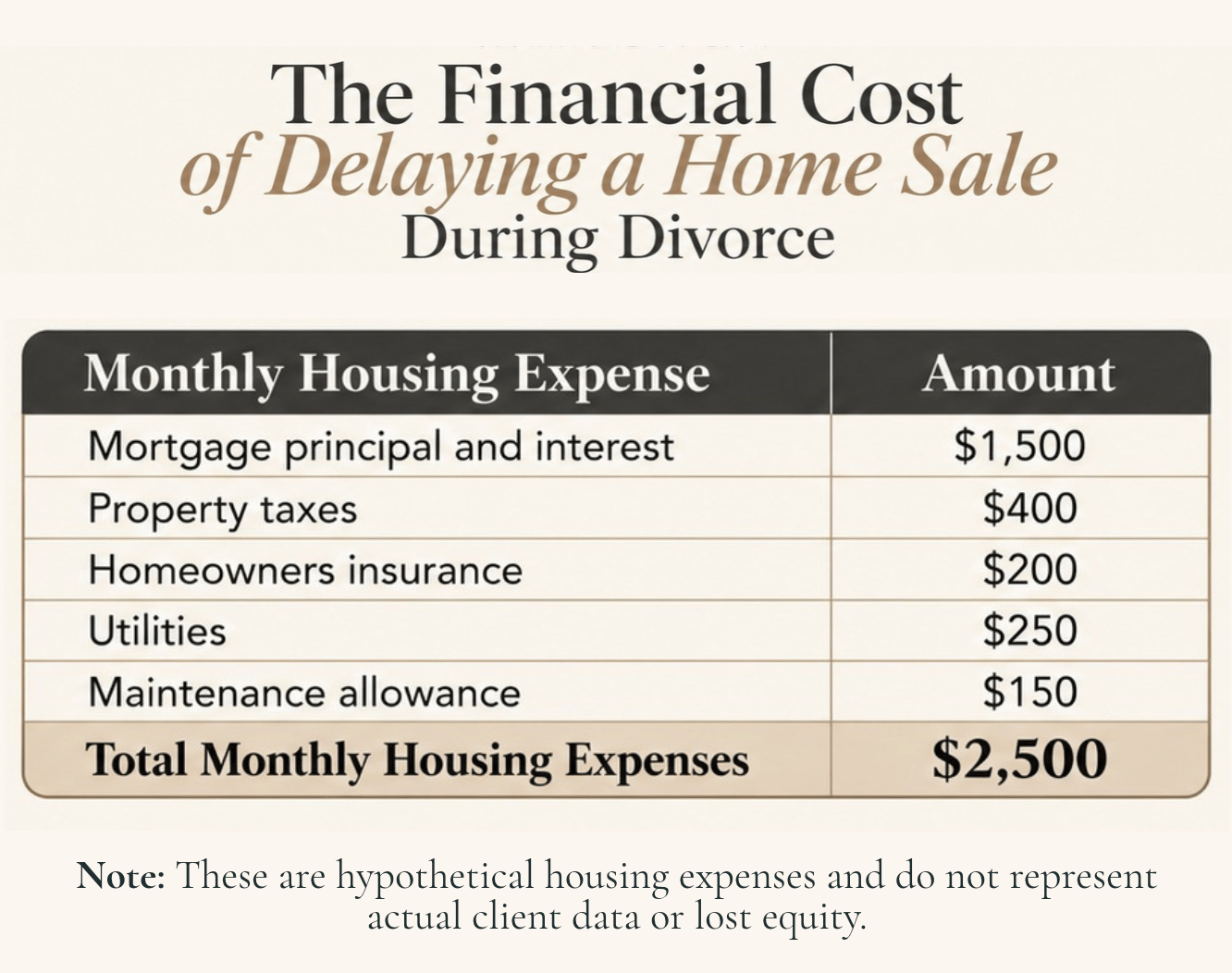
Over six months, that's approximately $15,000 in housing-related cash outflows.
Not all of that represents lost money. Mortgage principal payments can build equity, and someone may still be receiving the benefit of living in the property.
There may also be alternative housing expenses to consider.
But the financial obligations are real.
And when one or both spouses are trying to establish independent households, those numbers matter.
Agreeing to Sell and Cooperating With the Sale Are Two Different Things
WATCH: What Happens If One Spouse Refuses to Sell the House During a Divorce in Michigan?
What If My Spouse Agrees to Sell but Won't Cooperate?
This is where the real estate process can become considerably more complicated.
Getting agreement to sell the property is only the beginning.
There are decisions that need to be made throughout the entire transaction.
How will the property be prepared?
Who will provide access for photography?
When can buyers schedule showings?
How will the asking price be determined?
How will offers be evaluated?
What happens if the market tells us the asking price needs to change?
Who will coordinate access for inspections?
How will the required documents be signed?
These are not insignificant details.
Each one can influence whether a property sells successfully.
And when communication between spouses has broken down, decisions that would ordinarily be straightforward can become additional points of conflict.
That's why I believe the process needs to be addressed before the home enters the market.
The Buyer Isn't Part of Your Divorce
This is something I think is particularly important for homeowners to understand.
The buyer looking at your property is not evaluating your divorce.
They're evaluating your house.
They're looking at its condition.
Its location.
Its price.
Its competition.
And whether it represents a good financial decision for them.
They may have several other homes they're considering.
If they can't get into your property for a showing, they may move on.
If the house isn't adequately prepared, they may perceive less value.
If they submit an offer and decisions are repeatedly delayed, they may lose confidence in the transaction.
The circumstances surrounding the sale may explain why those obstacles exist.
But they don't necessarily change how a buyer responds to them.
And buyer response ultimately influences the outcome of the sale.
This is something I've explored in How Do Buyers Decide What to Offer on a Royal Oak Home?
A Court Order Doesn't Create Buyer Demand
A court may resolve whether a property needs to be sold.
But it cannot create buyer competition.
It cannot make the home show better.
It cannot make buyers accept an unsupported asking price.
And it cannot guarantee the financial outcome of the sale.
That's where real estate strategy comes in.
When I prepare a property for the market, I'm thinking about the entire buyer experience.
How does the buyer discover the property?
What do they see?
What information do they receive?
Can they easily schedule a showing?
Does the property meet the expectations created through its marketing?
Does the price make sense in relation to the competition?
Does the overall experience create enough confidence for them to write an offer?
Every part of that process matters.
Especially when the proceeds from selling the home may influence the financial future of two separate households.
Protecting the Equity You've Built Together
Your Home's Market Value and Your Available Equity Are Different Numbers
One of the first questions homeowners often ask during divorce is:
“What is our house worth?”
That's an important question.
But it's only the beginning.
Because what the house is worth and what may be available financially after selling it are two different numbers.
Consider this hypothetical example:
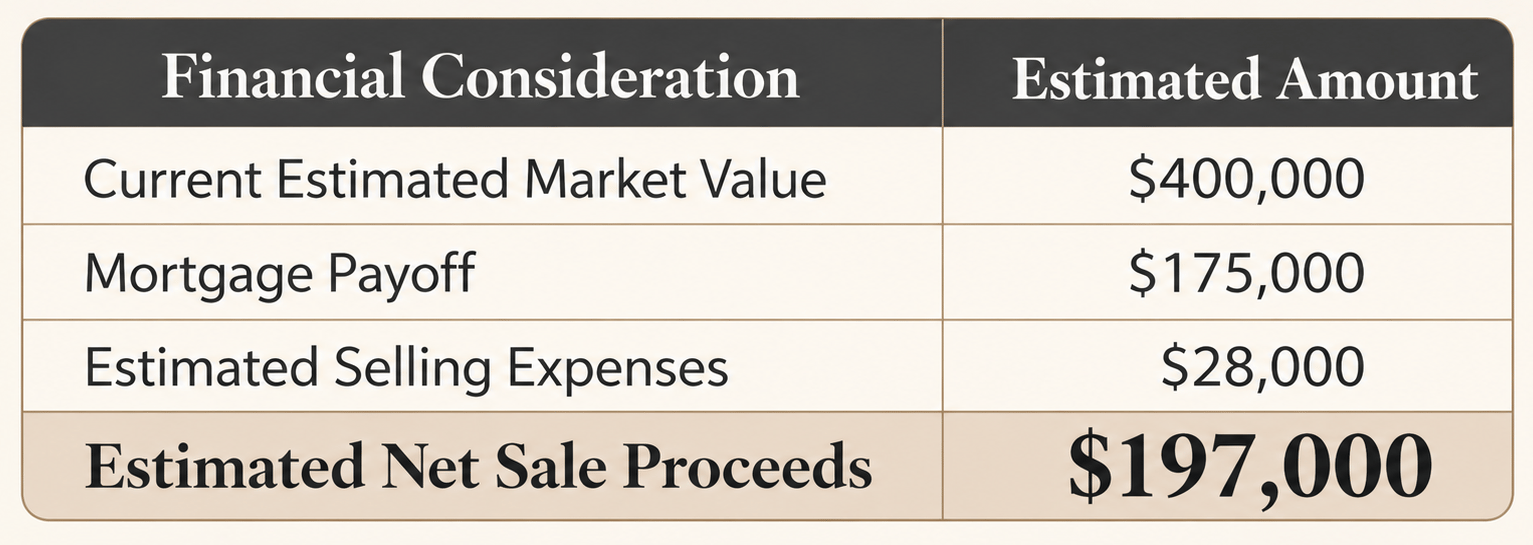
The $400,000 market value is not the amount available to divide.
The estimated $197,000 represents potential net proceeds before other obligations, settlement adjustments or court-directed allocations.
And that number can influence a much bigger conversation.
What housing options may be available after the sale?
How much might be available toward another purchase?
Could one spouse potentially retain the home through a buyout?
Would selling provide greater financial flexibility for both parties?
Understanding the approximate numbers can help both spouses and their attorneys evaluate the available options.
For a deeper explanation of how home equity is calculated, read How Much Equity Do I Have in My Metro Detroit Home?
What If We Disagree About What the House Is Worth?
This is another situation where emotion and financial expectations can become intertwined.
One spouse believes the house is worth $450,000.
The other believes it is worth $400,000.
An automated valuation says something different.
And perhaps a neighbor sold their home for another number entirely.
So where does the conversation begin?
With evidence.
Recent comparable sales.
Current competition.
Property condition.
Location.
Market activity.
Buyer demand.
A comparative market analysis can provide an informed estimate of the property's potential selling range. A formal appraisal may also be necessary or appropriate for divorce proceedings.
They serve different purposes.
And neither guarantees what a buyer will ultimately pay.
I've written about this distinction in What Is My Royal Oak Home Worth?
The real estate market does not determine value based on how much money either spouse needs or expects to receive.
The market responds to the property itself and the alternatives available to buyers.
Understanding that distinction early can help establish more realistic expectations.
Does Keeping the House Make More Financial Sense?
Sometimes it does.
Selling isn't necessarily the right decision for every divorcing homeowner.
But wanting to keep the house and being financially positioned to keep it are different things.
A spouse considering retaining the home needs to understand the ongoing expenses associated with ownership.
They may also need to explore refinancing, an equity buyout or other arrangements with their attorney and mortgage professional.
And it's important to understand that removing someone's name from a deed does not automatically release that person from mortgage obligations.
These are financial and legal considerations that need to be evaluated before a decision is made.
I've addressed this question in greater detail in Should You Keep or Sell Your Home After Divorce in Michigan?
What Should Be Established Before the House Goes on the Market?
When selling is the agreed or legally authorized direction, I believe the practical process should be defined as clearly as possible before launching the listing.
Establish the Authority to Sell
The appropriate attorneys and title professionals should confirm who has authority to authorize the listing, approve decisions and execute the necessary documents.
If a court order is involved, the real estate process must be consistent with that order.
Establish the Property's Market Position
Determine its estimated market value, current competition, condition and preparation requirements.
The objective is to establish a realistic starting point supported by market evidence.
Establish Access and Showing Procedures
Determine how professional photography, showings, inspections and other necessary appointments will be coordinated.
A property that buyers cannot conveniently access may struggle to generate demand.
Establish the Pricing and Offer Process
Determine how market information will be communicated, how proposed price adjustments will be addressed and how offers will be evaluated.
If the parties cannot agree on who has authority to make these decisions, that issue belongs with their attorneys.
Establish Communication Expectations
Both parties need to understand how information will be handled in accordance with their representation arrangements, confidentiality requirements and legal instructions.
Where appropriate and authorized, attorneys may also be involved in the communication process.
Direct communication between spouses may not always be appropriate or safe.
The structure should reflect the circumstances of the individuals involved.
The purpose is not to resolve the personal disagreements surrounding the divorce.
The purpose is to establish a real estate process that can function despite them.
The Signature by Lisa Perspective
I've been through divorce.
I've experienced the uncertainty of changing households and figuring out what the next chapter of my life would look like.
And I understand that the decisions surrounding your home can feel considerably bigger than the house itself.
Where will I live?
What can I afford?
What will my financial situation look like?
How do I make decisions when so much of my life is already changing?
Those are real concerns.
And I don't believe a homeowner in that situation necessarily needs a real estate agent to immediately start talking about listing the house.
I believe they need information first.
They need to understand the asset.
They need to understand the numbers.
They need to understand what a successful sale would require.
And they need to understand what their options may look like before making decisions that could affect their financial future for years.
My professional responsibility is to manage the real estate side of the process.
Prepare. Present. Position. Market. Create demand. Evaluate. Negotiate.
One strategy.
The circumstances surrounding the sale may be different.
But protecting the property's marketability remains important.
The Next Question: What Would Selling Actually Accomplish?
Before deciding whether the house should be sold, I think there's a question worth asking:
What would selling actually accomplish for you financially?
You may have substantial equity.
You may have considerably less than you expected.
You may discover that retaining the home creates more financial pressure than you realized.
Or that selling could provide resources that make establishing your next household more achievable.
Until you understand those numbers, you're making decisions without the complete financial picture.
And it's possible that both spouses are doing exactly that.
You don't necessarily have to agree to sell the house before gathering information about it.
Understanding your options and committing to a transaction are two different things.
Frequently Asked Questions
What if my spouse doesn't want to sell the house during divorce?
If spouses cannot agree, a Michigan family court may determine whether one spouse retains the property or whether it must be sold. A family law attorney can explain the available legal options, while a real estate professional can help estimate market value and potential sale proceeds.
Can a judge force the sale of a marital home in Michigan?
Yes. A Michigan judge may order the sale of a marital home as part of dividing marital property. The decision depends on the circumstances of the divorce and the overall property settlement.
What happens if my spouse refuses to cooperate after agreeing to sell?
Refusing access, delaying decisions or withholding necessary signatures can interfere with the selling process. If legal obligations or court orders are involved, consult your family law attorney about available remedies.
Can I sell my house during divorce without my spouse's signature?
The signatures and legal authority required depend on ownership, applicable agreements and court orders. An attorney and title company should confirm the requirements before proceeding with a sale.
Do I lose my rights to the marital home if I move out?
Moving out during divorce does not automatically eliminate an existing property interest in the marital home. Other legal and practical considerations may apply, so consult your family law attorney before making that decision.
Who pays the mortgage while we disagree about selling?
Responsibility depends on the loan documents and applicable agreements or court orders. If both spouses are borrowers, a divorce-related arrangement generally does not independently release either borrower from obligations to the lender.
Can I speak with a REALTOR® before my spouse agrees to sell?
Yes. You can seek general real estate guidance about estimated market value, home equity and potential selling options without committing to list the property. Property access and authorization requirements must still be respected.
Conclusion
A spouse refusing to sell the marital home introduces a complicated set of decisions.
Some are legal.
Some are financial.
Some are emotional.
And some are specifically related to the real estate transaction.
Those responsibilities should not be confused.
Your attorney can help you understand your rights, obligations and available legal options.
Your mortgage professional can help you understand financing and affordability.
Your REALTOR® can help you understand the property's market value, potential net proceeds and what it would take to position the home effectively if selling becomes the decision.
Each professional has a role.
And understanding those roles can help create a more organized process during an already difficult transition.
Closing Thoughts
The house may be one of the things you disagree about.
But the equity inside it may represent years of financial investment.
Years of mortgage payments.
Years of ownership.
And potentially a significant financial resource for your individual futures.
That deserves thoughtful consideration.
Because deciding to sell a house and protecting its value throughout the selling process are not the same thing.
The first step is understanding what you have and what your options may be.
Let's Understand Your Real Estate Options
If you're navigating divorce in Metro Detroit and uncertain about what should happen to your home, we can begin by looking at the property itself.
I'll help you understand its estimated current market value, potential net proceeds and the practical considerations associated with selling.
You don't need to have your divorce finalized.
You don't need to have every decision made.
And you don't need to be ready to put a sign in the yard.
You can begin with information.
REQUEST A PRIVATE REAL ESTATE CONSULTATION
This article provides general real estate education and is not legal, tax or financial advice. Consult qualified professionals regarding your individual circumstances.
About Lisa A. Mills
Lisa A. Mills is a REALTOR®, founder of Signature by Lisa, and is affiliated with National Realty Centers | Powered by JMG. She specializes in helping Metro Detroit homeowners confidently navigate life’s transitions through strategic planning, local market expertise, and innovative digital marketing.
Known as The Calm Strategist When Life Shifts, Lisa believes selling a home begins with understanding—not assumptions. Through thoughtful preparation, strategic pricing, and a focus on buyer confidence, she helps homeowners make informed decisions that lead to stronger outcomes.